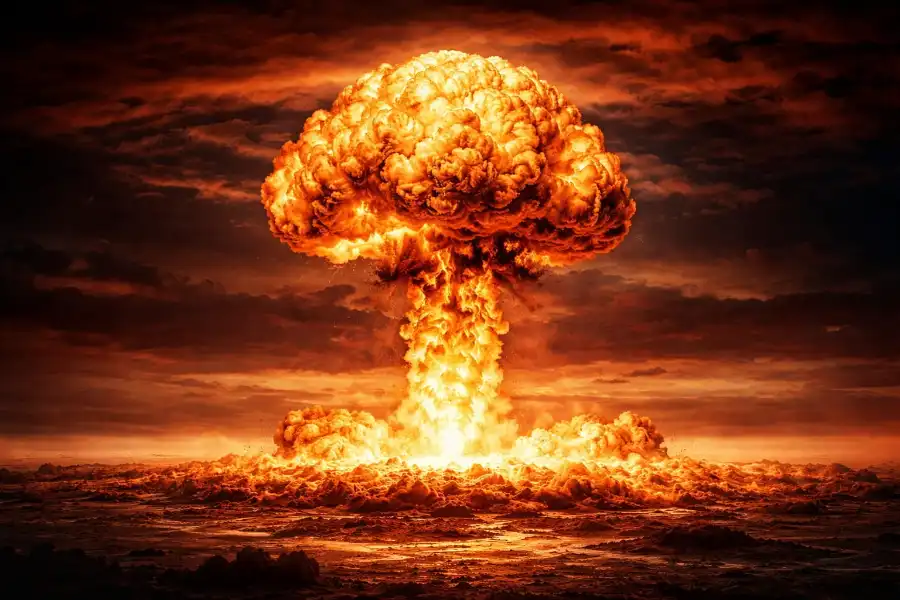
Nuclear weapons represent humanity's most destructive creation—bombs capable of obliterating entire cities in seconds and poisoning the earth with radiation for generations. First developed during World War II through the top-secret Manhattan Project, these weapons of mass destruction were unleashed on Hiroshima and Nagasaki in August 1945, killing over 200,000 people and forcing Japan's surrender. This comprehensive guide explores the history of nuclear bombs from their scientific origins to their devastating effects, the Cold War arms race that brought the world to the brink of annihilation, and how the threat of mutual assured destruction continues to shape global politics today. Understanding nuclear weapons' legacy is essential to comprehending modern warfare, international relations, and the existential threat facing humanity.
Table of Contents
What is a Nuclear Weapon? Fission vs Fusion Bombs Explained
A nuclear weapon, also called an atomic bomb or A-bomb, uses the power of nuclear reactions to cause immense destruction. The nuclear reaction might either be a fission reaction or a fusion reaction. A fission reaction works by splitting an atom into smaller parts which then splits other atoms causing a chain reaction. This releases an enormous amount of energy capable of destroying entire cities. The atomic bombs dropped on Hiroshima and Nagasaki in 1945 were fission bombs that changed warfare forever.
The other type of nuclear weapon is the even more powerful fusion bomb. In this case, two or more atoms combine together to form new atoms. The difference in mass of the atoms is released as energy causing a huge blast. This is called as a thermonuclear weapon or a hydrogen bomb which is many times stronger than a nuclear bomb. To give you a perspective on the difference in power, the first nuclear bomb ever used released energy equivalent to 20,000 tons of TNT whereas the first thermonuclear weapon was as powerful as 10 million tons of TNT!
Devastating Effects of a Nuclear Explosion: Blast, Heat, and Radiation
The power and intensity of a nuclear bomb are many times more effective than a normal gunpowder explosion. As mentioned earlier a 1,100kg thermonuclear weapon generates energy equal to 1.2 million tons of TNT. Anyone or anything within the vicinity of the explosion would be completely obliterated. Shockwaves from the explosion would cover an even wider radius collapsing buildings and killing people.
The heat from the explosion would also cause third-degree burns to people who manage to survive the blast intensity. The bombs would ideally be dropped in a highly populated city which would maximize the death count. Many people would be blinded by the intense light generated and eardrums would explode. The explosion creates a large mushroom-like cloud of smoke high into the sky.
This is not, however, the full intensity of its destructive force. More damage would be caused by radiation poisoning caused by the nuclear reaction as radioactive debris cover the entire area. Those who are affected by the radiation would die a slow painful death. Radiation poisoning would slowly kill thousands of people weeks, months or even years after the explosion.
Long-Term Radiation Poisoning and Nuclear Fallout Consequences
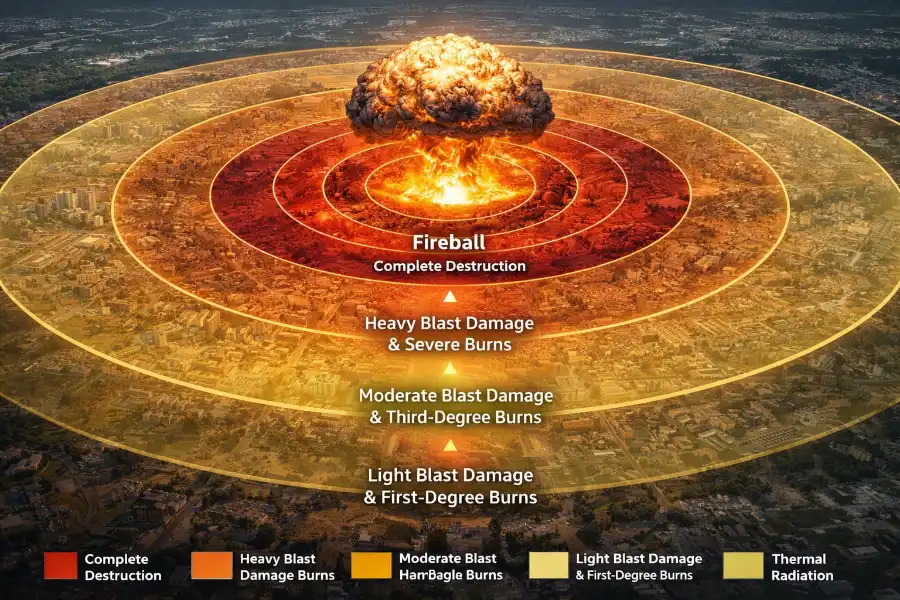
The immediate impact of the bomb would wipe out buildings in about one square kilometer of the blast. Buildings which are further away may collapse or have severe damage. The loss of life and property would be huge. Windows would shatter miles from the area of the blast but this is just the start of the effects.
Radiation poisoning is the most major cause of concern when using atomic weapons. When humans are exposed to radiation, there are a number of complications that occur. Too much exposure would result in the immediate death of the person. Those who are unfortunate enough to come into contact would them would be scarred for life with ailments like infertility.
It doesn't stop with the current generation as well. The land in which the bomb was dropped would be contaminated with nuclear waste and will remain uninhabitable. The children born of the people affected by the nuclear waste would also not be spared. Cancer and deformity are only a few of the issues that they would have to face.
Manhattan Project and Nuclear Weapons in WW2: Hiroshima and Nagasaki
The atomic bomb was first used during WW2. The Allies, as well as the Axis countries, were researching the possibility of creating a weapon by splitting the atom. The US won the race and created the first nuclear weapon through the Manhattan Project. This top-secret program responsible for the creation of the atomic bomb cost 2 billion US dollars. The first test bomb was detonated on 16 July 1945 in New Mexico.
The nuclear bomb was created to put an end to the war early. Germany had already surrendered but Japan was still fighting on to the last man. The Allies knew that invading the Japanese mainland would cost the lives of millions of people. So, they wanted to use the atomic bomb to crush the Japanese without the need for an invasion.
The Allies justified the use of the atomic bomb stating that forcing Japan to surrender by the use of this weapon would bring the end of the war without the loss of too many lives. They hoped that Japan would surrender without the Allies having to invade the Japanese mainland. This worked as expected but the gruesome power of the atomic bomb was more than anyone had ever anticipated.
On August 6, 1945, the atomic bomb "Little Boy" was dropped on Hiroshima, followed by "Fat Man" on Nagasaki three days later. These nuclear bombings of Hiroshima and Nagasaki were designed to maximize civilian casualties. The bombs decimated both cities, killing everyone within their vicinity instantly. Those who didn't die immediately would face years of struggle and pain from radiation sickness. These atomic bombs would never be used in war again.
Cold War Nuclear Arms Race and Mutually Assured Destruction (MAD)
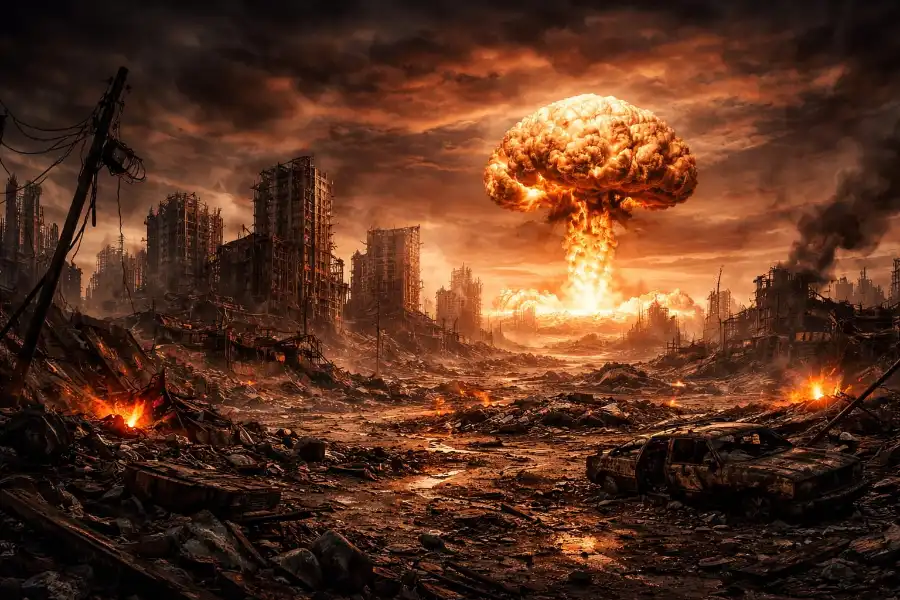
Nuclear weapons are a threat to humanity itself. Only a handful of countries around the world possess nuclear arsenals capable of global destruction. The purpose of these weapons is to act as a deterrent. Any country would think twice before attacking a nuclear-armed nation.
During the Cold War, the US and Soviet Union engaged in a nuclear arms race that brought humanity to the brink of extinction. The Cuban Missile Crisis and other tense moments nearly triggered nuclear war. The doctrine of Mutually Assured Destruction (MAD) paradoxically kept the peace—both superpowers knew that launching nuclear weapons would guarantee their own annihilation. This weapon is a double-edged sword which can help but harm us as well.
Nuclear Energy: Peaceful Uses Beyond Weapons of War
Although nuclear weapons are dangerous, they can also help us maintain peace. The presence of nuclear weapons is the main reason why we are yet to have a world war 3. They act as a deterrent to avoid any unnecessary conflicts. But creating deadly weapons is not the only purpose of nuclear power. Nuclear power plants have been created to supply us with a reliable source of energy.
Although the nuclear power plants are sometimes unstable and accidents have occurred earlier, a properly maintained nuclear power reactor is safe. They also provide us with a clean source of energy without the emission of any harmful gases or pollutants. One thing is clear. Nuclear power may be dangerous for humans but it is something which presents us with a myriad of opportunities if used correctly.