The Third Punic War (149-146 BC) was the final and most brutal chapter in the century-long struggle between Rome and Carthage. Unlike the earlier Punic Wars that saw massive armies clash across Italy, Spain, and the Mediterranean, the Third Punic War became a relentless campaign of annihilation that ended with the destruction of one of the ancient world's greatest cities.
For over 100 years, Rome and Carthage had fought for control of the Mediterranean. Their rivalry produced legendary commanders, catastrophic battles, and some of the most dramatic military campaigns in ancient history. From the naval innovations of the First Punic War to the stunning victories of Hannibal during the Second Punic War, the conflict between these two powers reshaped the balance of power in the ancient world.
But by the mid-2nd century BC, Rome was determined to eliminate its old rival once and for all. What followed was a brutal three-year siege that culminated in the fall of Carthage in 146 BC — an event so devastating that it permanently altered the political landscape of the Mediterranean.
Table of Contents
- Background: The Rivalry Between Rome and Carthage
- Summary of the First Punic War (264-241 BC)
- The Second Punic War (218-201 BC): Hannibal's Legendary Campaign
- Carthage After the Second Punic War
- The Economic Boom of Carthage After the Second Punic War
- The Immediate Causes of the Third Punic War
- Roman Demands and the Carthaginian Crisis
- The Siege of Carthage (149-146 BC)
- The Arrival of Scipio Aemilianus
- The Final Assault on Carthage (146 BC)
- The Destruction of Carthage
- Significance of the Third Punic War
- Conclusion
- Related Articles
Background: The Rivalry Between Rome and Carthage
The Punic Wars were a series of three wars fought between Rome and Carthage between 264 BC and 146 BC. These conflicts determined which civilization would dominate the Mediterranean world. Carthage was a powerful maritime trading empire based in North Africa, while Rome was a rapidly expanding land-based republic in Italy.
The rapid expansion of the Roman Republic made conflict with Carthage inevitable. Their rivalry began over control of Sicily but quickly escalated into a struggle for supremacy across the entire Mediterranean. To fully understand the causes of the Third Punic War, it is necessary to examine the conflicts that had occurred between the two powers earlier.
Summary of the First Punic War (264-241 BC)
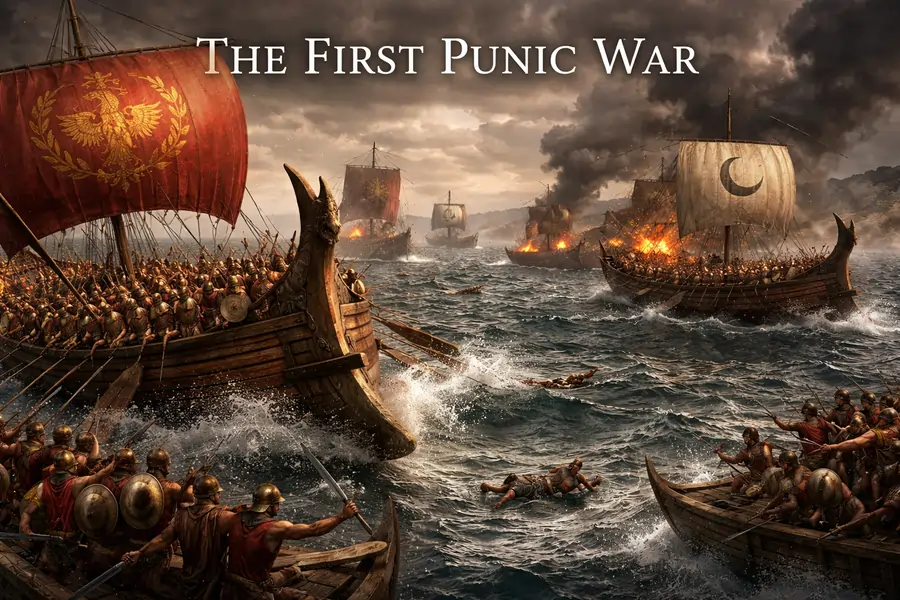
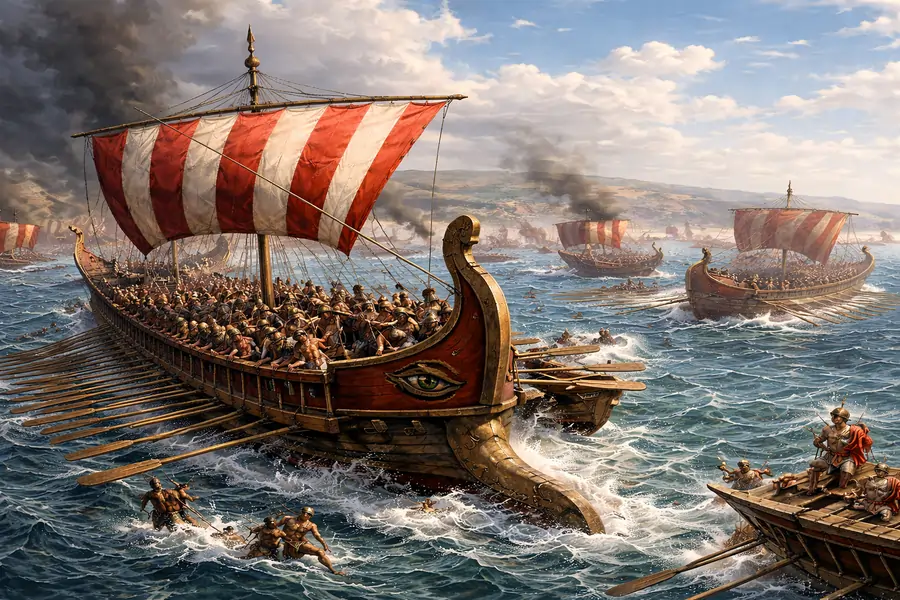
The First Punic War was the first major conflict between Rome and Carthage and lasted for 23 years. The conflict began as a minor skirmish over control of Sicily and soon turned into a full-blown war. At the beginning of the First Punic War, Carthage possessed one of the most powerful navies in the ancient world, while Rome had very little naval experience. The Romans were, however, unbeatable on land, which created a stalemate. This would change soon, however, when the Romans adapted and developed innovative tactics that allowed them to challenge Carthaginian naval dominance.
One of Rome's most important innovations during the war was the Roman Corvus, a boarding bridge that allowed Roman soldiers to turn naval battles into infantry combat, where the Roman legions quickly dominated their opponents. It was a back-and-forth conflict with major losses for both Rome and Carthage. Major naval battles such as Mylae and the Aegates Islands eventually tipped the balance in Rome's favor.
Carthage did not prefer to continue a war that was no longer sustainable or profitable for them. So by 241 BC, the exhausted Carthaginians sued for peace. The terms of the treaty were harsh:
- Carthage lost control of the island of Sicily.
- It was forced to pay a massive war indemnity to Rome.
- Rome emerged as the dominant naval power in the western Mediterranean.
For a complete breakdown of the war, see: First Punic War: Rome vs Carthage.
The Second Punic War (218-201 BC): Hannibal's Legendary Campaign
The First Punic War had established Rome as the dominant naval power in the region. However, Carthage was not happy with the terms of the First Punic War, which led to the start of the Second Punic War. This would play out to be one of the most famous military campaigns in history.
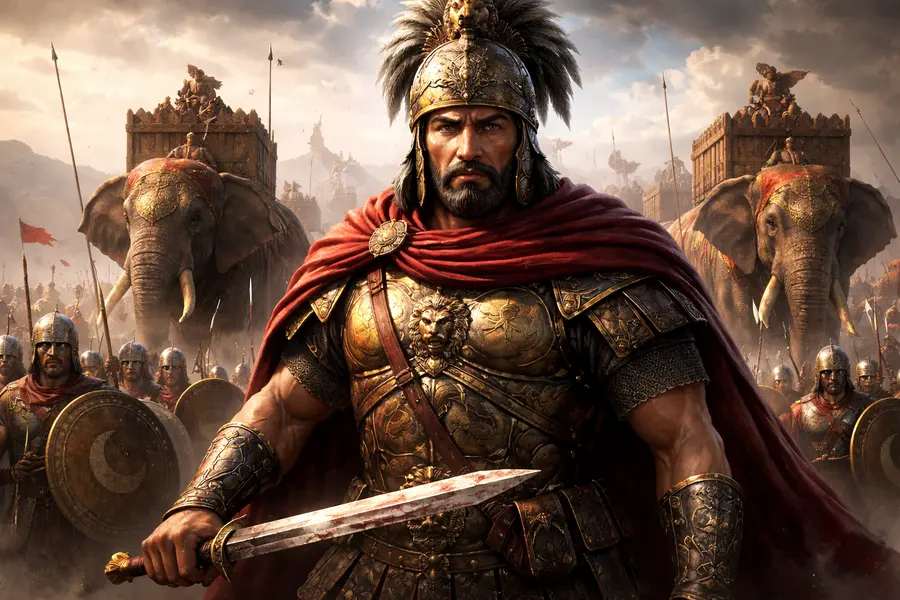
The war was largely defined by the brilliant Carthaginian general Hannibal Barca, widely considered one of the greatest commanders in military history. Hannibal had sworn an oath to never be a friend of Rome. He shocked the Roman world by leading his huge army - including war elephants - across the Alps and invading Italy itself. Over the next few years, he inflicted a series of devastating defeats on Roman armies that brought Rome to its knees. These battles remain some of the most studied engagements in military history.
Battle of Trebia (218 BC)
Hannibal's first major victory in Italy came at the Battle of Trebia. By taunting the impatient Roman commander, Hannibal led them into a clever ambush. By using deception and harsh winter conditions to his advantage, Hannibal trapped a Roman army and destroyed it.
Battle of Lake Trasimene (217 BC)
The following year, the Romans were caught in the greatest ambushes in history at the Battle of Lake Trasimene. The Roman army was deceived and surrounded as it marched into a chokepoint between the mountains and the lake. The Roman legion was destroyed.
Battle of Cannae (216 BC)
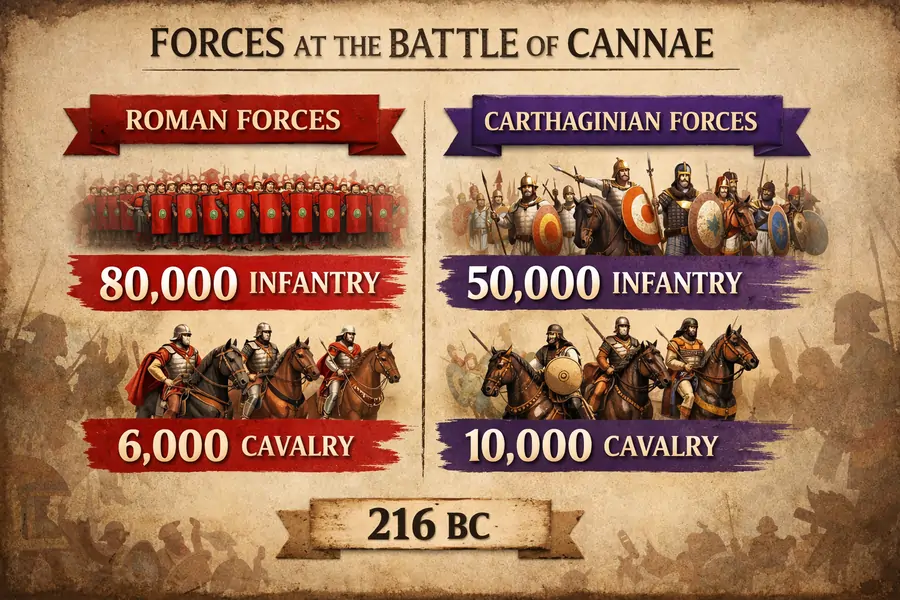
The most famous battle of the war was the Battle of Cannae. Hannibal showcased the use of the double-envelopment maneuver, where he crushed the largest army the Romans had ever assembled. The Battle of Cannae is still taught in military academies around the world.
Despite these victories, Hannibal was unable to capture Rome. The Roman Republic was devastated, but it did not surrender. They raised new armies and pushed back Hannibal. Eventually, the Roman general Scipio Africanus invaded North Africa and defeated Hannibal at the Battle of Zama in 202 BC.
Carthage After the Second Punic War
The defeat at Zama imposed extremely harsh conditions on Carthage.
- Carthage lost all of its overseas territories, including Spain.
- Its navy was reduced to only ten ships, which was not enough to defend itself against any aggressors.
- It was forced to pay huge war reparations to Rome.
- Carthage could not wage war without Roman permission.
Carthage, once a great power, was now reduced to a puppet state. They were, however, in no position to oppose Rome and accepted the terms.
The Economic Boom of Carthage After the Second Punic War
Rome had imposed such harsh conditions in the hope that Carthage would never be able to rise again. However, something unexpected happened over the following decades. Despite the conditions imposed in the humiliating peace deal, Carthage experienced a remarkable economic recovery. Its merchants rebuilt trade networks across North Africa and the Mediterranean. Agriculture flourished, and the city once again became wealthy.
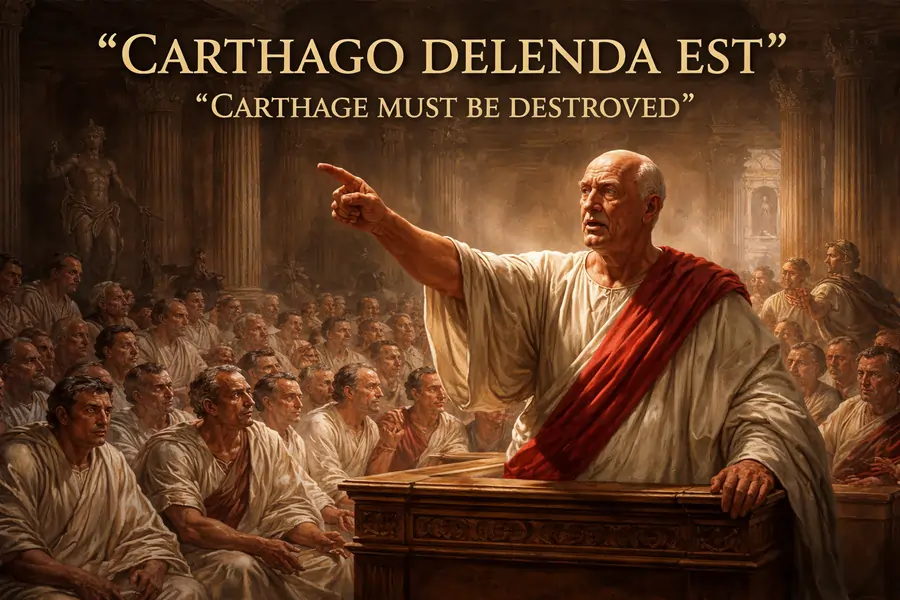
Carthage's economic revival did not go unnoticed in Rome. Many Roman politicians feared that Carthage might eventually regain its former power and influence. One of the most famous critics of Carthage was the Roman senator Cato the Elder, who ended every speech in the Senate with the phrase:
"Carthago delenda est" - "Carthage must be destroyed."
The Immediate Causes of the Third Punic War
While Roman fear and jealousy played a role, the immediate cause of the Third Punic War involved the Numidian king Masinissa. Masinissa was a Roman ally who ruled the neighboring kingdom of Numidia. Over the years following the Second Punic War, Masinissa capitalised on the weakened Carthaginian army and repeatedly captured their territory.
Carthage appealed to Rome for settling the dispute, but Rome consistently sided with Masinissa. Eventually, Carthage could no longer tolerate the ongoing territorial losses. In 151 BC, Carthage finally raised an army under Hasdrubal and fought against Masinissa without Roman permission. The campaign was a complete disaster that ended with the Carthaginian loss at the Battle of Oroscopa, where the Carthaginian army surrendered.
According to the treaty signed at the end of the Second Punic War, Carthage was forbidden from waging war without Rome's approval. This action technically violated the treaty, and Rome seized the opportunity. In 149 BC, the Roman Senate declared war on Carthage, beginning the Third Punic War.
Roman Demands and the Carthaginian Crisis
Carthage attempted to avoid war by all means possible. They were not capable or prepared enough to fight a war against the mighty Romans. Rome initially demanded:
- 300 noble children as hostages to be sent to Rome
- Surrender of all Carthaginian weapons
- Complete disarmament of the city
Carthage complied with these demands as it could never hope to win against the might of Rome. When the Roman army landed in North Africa, the Carthaginians surrendered all their weapons. However, Rome soon issued a final ultimatum that shocked the Carthaginians. The Romans demanded that the entire population abandon the city of Carthage and move at least ten miles inland. The city of Carthage would be destroyed brick by brick.
This demand was unacceptable to the Carthaginians. They realized that the Romans wanted to destroy their civilization entirely. This forced the Carthaginians to fight to the bitter end. The entire city was mobilized for total war.
The Siege of Carthage (149-146 BC)
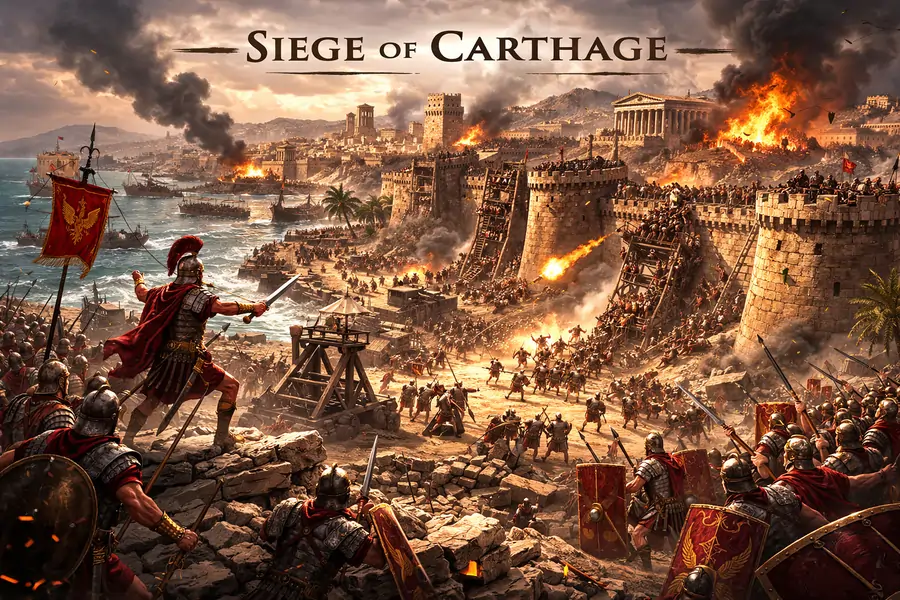
The major event of the Third Punic War was the long and brutal Siege of Carthage, which lasted from 149 BC to 146 BC. The earlier two Punic Wars were an evenly matched contest. However, the final conflict between Rome and Carthage was heavily one-sided, with Rome besieging Carthage for the entirety of the war.
When the Romans declared war in 149 BC, they sent a powerful expeditionary force to North Africa, determined to eliminate Carthage once and for all. The initial attempts by the Carthaginians to appease the Romans failed, and the Roman army marched straight for Carthage and laid siege to the city. The Carthaginians soon realized that Rome intended nothing less than the destruction of their civilization.
Faced with this existential threat, Carthage mobilized its entire population for total war. All citizens of Carthage - including merchants, craftsmen, farmers, and even women — participated in the desperate effort to defend their homeland. Thousands of weapons were manufactured day and night inside the city. Ancient historians describe an extraordinary wartime mobilization:
- Thousands of swords, shields, and spears were produced daily in improvised workshops.
- Women famously cut their hair to produce rope and cords for siege engines and catapults.
- Blacksmiths, artisans, and laborers worked continuously to supply the defenders.
- Even sacred temples were stripped of metal and resources to create weapons.
The Carthaginians had surrendered all their military equipment earlier to appease the Romans. Despite this setback, the Carthaginians managed to rebuild a formidable defensive force in a remarkably short time. Carthage had also managed to partially rebuild its navy, which initially took the Romans by surprise. The city of Carthage itself was one of the most heavily fortified cities in the ancient world. Its defenses included:
- Massive triple-layered defensive walls stretching nearly 34 kilometers around the city.
- Walls that were wide enough to house barracks, stables, and defensive towers.
- A complex harbor system that included both a commercial port and a circular military harbor known as the Cothon.
- Strong natural defenses with the sea protecting much of the city.
The defenses of the city were formidable and initially frustrated the Romans. Early assaults launched by the Roman consuls were poorly coordinated and resulted in heavy casualties. The Carthaginians also demonstrated surprising ingenuity and resilience during the siege. In one assault, they secretly constructed an entirely new fleet inside their harbor after the Romans had captured their ships. When the new ships were completed, they suddenly launched an attack against the Roman blockade, shocking the Roman commanders.
For a city that prioritized profit over victory, Carthage was now facing an existential crisis. They were now willing to fight with everything they had. Although these surprise attacks achieved some success, they were not decisive. Rome faced repeated failures in 149 BC. A new Roman commander was appointed in 148 BC to turn the tide of battle, but there was no improvement to the Roman situation.
The Arrival of Scipio Aemilianus
The turning point of the war came with the arrival of the Roman commander Scipio Aemilianus in 147 BC. Dissatisfied with the slow progress of the siege, the Roman Senate lifted the age restrictions to grant the young Scipio command of the campaign.
Scipio Aemilianus had a powerful legacy. He was the adopted grandson of Scipio Africanus, the Roman hero who had defeated Hannibal at the Battle of Zama and ended the Second Punic War. Determined to bring a quick end to the war, Scipio immediately reorganized the Roman forces. He enforced strict discipline, removed ineffective officers, and ensured that the Roman legions operated with greater coordination and efficiency.
Under his leadership, the Romans intensified the siege. Scipio ordered the construction of an enormous circumvallation wall surrounding Carthage, effectively trapping the population inside the city and preventing reinforcements or supplies from reaching them. These siege works included:
- A fortified wall encircling the city to cut off land access.
- Large defensive towers to monitor Carthaginian movements.
- A massive embankment was built across the harbor entrance to block naval access.
- Additional fortifications protecting Roman siege camps.
This strategy gradually weakened the defenders. With Carthage completely cut off, food supplies dwindled, and disease spread inside the crowded city. Despite the hardships they faced and starvation setting in, the Carthaginian resistance remained fierce, and the defenders fought with extraordinary determination. Carthaginian forces launched several desperate counterattacks against Roman siege positions. However, Rome's overwhelming military power and superior logistics slowly began to turn the tide.
The Final Assault on Carthage (146 BC)
By early 146 BC, the situation inside Carthage had become desperate. Years of blockade had exhausted the city's resources, and most of the defenders were already weakened by hunger and disease. Sensing that the moment had come, Scipio Aemilianus ordered a final assault to take the city. Roman forces first captured key defensive positions around the harbor, allowing them to break through Carthage's outer defenses. Once inside the city walls, the Romans encountered fierce resistance from Carthaginian defenders fighting among the streets and buildings.
What followed was one of the most brutal episodes of urban warfare in ancient history. Roman soldiers advanced slowly and methodically through the city, clearing each street through intense fighting. Carthaginian defenders used rooftops, narrow streets, and fortified houses to resist the Roman advance. The battle quickly turned into a terrifying house-to-house struggle. Roman troops had to fight their way through barricaded streets to gain every inch of ground within the city.
The fighting continued relentlessly for six days. The Romans massacred every civilian they could find without taking any prisoners. Eventually, the surviving defenders retreated to the Byrsa, the heavily fortified citadel that dominated the city. Thousands of civilians also gathered there in a final desperate stand. When the Roman army finally captured the Byrsa, the last organized resistance collapsed. The aftermath was catastrophic for Carthage:
- Large sections of the city were burned to the ground.
- Tens of thousands of inhabitants were killed during the fighting.
- Lower end estimates indicate that 62,000 Carthaginians were killed in the city.
- Approximately 50,000 survivors were captured and sold into slavery.
The Destruction of Carthage
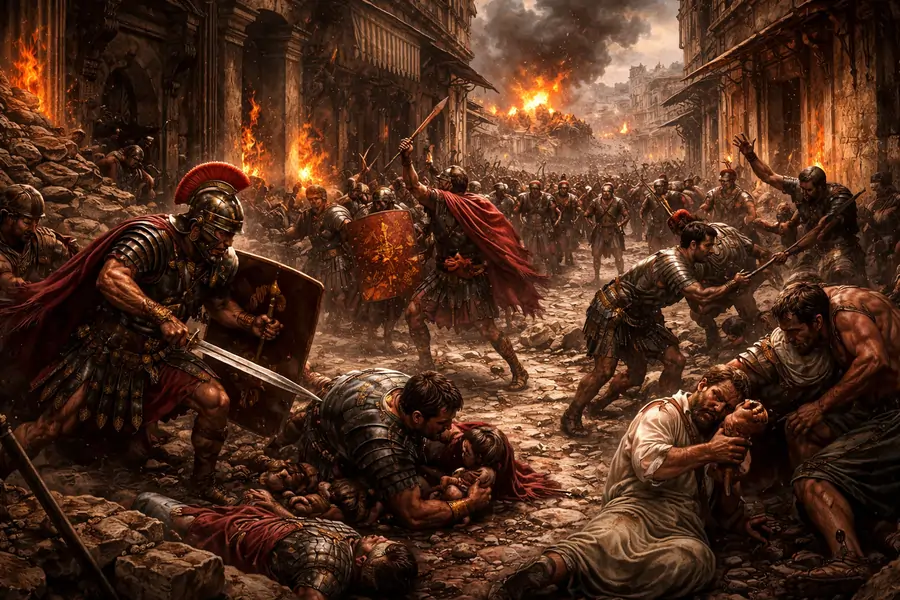
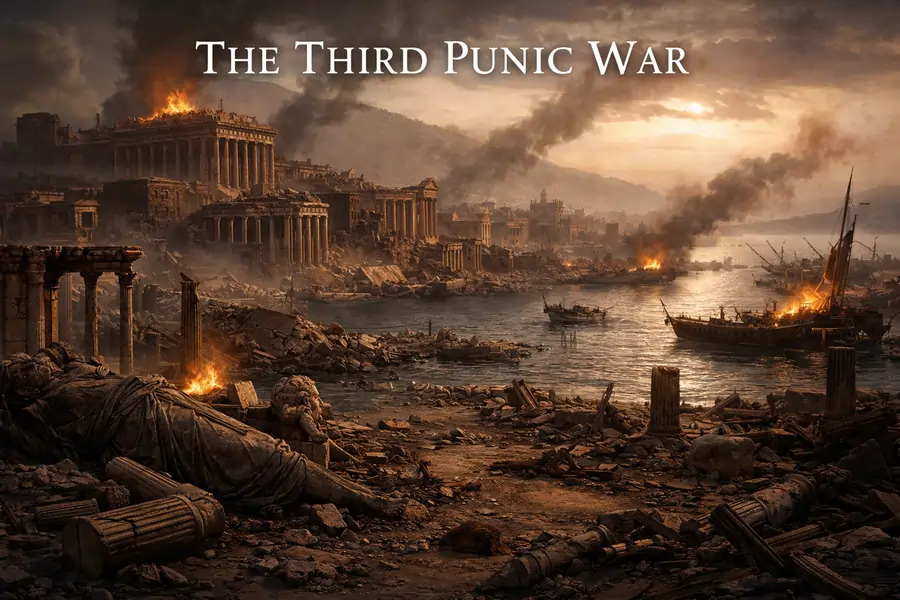
The great city of Carthage, which once challenged the might of Rome, was now destroyed. After the victory, the Romans began the systematic destruction of the city. Buildings were demolished, temples were looted, and large sections of the city were burned. Ancient historians describe fires that continued burning for days as Roman soldiers dismantled what remained of the once-magnificent city.
Although legends claim that the Romans salted the earth to prevent the city from ever being rebuilt, modern historians believe this story is largely symbolic rather than literal. Nevertheless, the destruction of Carthage was nearly total. The city of Carthage was wiped from the face of the map. Following the war, the territory of Carthage was reorganized into the Roman province of Africa, which would later become one of the most important agricultural regions of the Roman Empire. With the destruction of Carthage, Roman dominance in the western Mediterranean became uncontested.
Significance of the Third Punic War
The destruction of Carthage in 146 BC marked a turning point in ancient history. The consequences of the Third Punic War reshaped the Mediterranean world and accelerated the rise of the Roman Empire.
1. Rome Became the Dominant Mediterranean Power
With Carthage eliminated, Rome no longer faced any serious rival in the western Mediterranean. The republic now possessed unmatched military and economic power in the region. After the First Punic War, Rome had also become a naval superpower, expanding its influence further. The destruction of Carthage allowed Rome to consolidate control over North Africa while strengthening its influence across Spain, Sicily, Sardinia, and other Mediterranean territories.
2. Transformation of Roman Society
Rome's expanding empire brought enormous wealth, resources, and slaves into the republic. These changes transformed Roman society, contributing to economic inequality, political tensions, and eventually the rise of powerful military leaders.
3. The End of Carthaginian Civilization
The fall of Carthage marked the end of one of the most important trading civilizations of the ancient Mediterranean. For centuries, Carthaginian merchants had dominated commerce across North Africa, Spain, and the Mediterranean Sea. Despite its destruction, the legacy of Carthage lived on through the stories of its greatest commanders - especially Hannibal, whose campaigns during the Second Punic War remain legendary. His victories at the Battle of Trebia, Battle of Lake Trasimene, and Battle of Cannae are still studied as masterpieces of battlefield tactics.
Conclusion
The Third Punic War represents one of the most dramatic endings to the greatest rivalry in ancient history. What began as a struggle for control of Sicily during the First Punic War ultimately ended with the destruction of one of the Mediterranean's greatest cities.
Rome emerged from the Punic Wars as the undisputed superpower of the western Mediterranean. Yet these wars also revealed the extraordinary resilience of the Roman Republic in times of desperation and the brilliance of Carthaginian commanders such as Hannibal. The fall of Carthage in 146 BC marked the beginning of a new era — one in which Rome would expand across the Mediterranean and eventually become the dominant empire of the ancient world.
Frequently Asked Questions
What was the Third Punic War?
The Third Punic War (149-146 BC) was the final conflict between Rome and Carthage. Unlike the earlier Punic Wars that involved large campaigns across the Mediterranean, the Third Punic War was primarily a prolonged siege of the city of Carthage. The war ended with the complete destruction of Carthage by Roman forces under Scipio Aemilianus in 146 BC.
What caused the Third Punic War?
The Third Punic War was triggered by tensions between Carthage and the neighboring kingdom of Numidia. When Carthage fought back against Numidian aggression without Roman approval, it technically violated the treaty that ended the Second Punic War. Rome used this as a justification to declare war, though many Roman leaders had long believed that Carthage should be destroyed.
Who won the Third Punic War?
Rome won the Third Punic War after a three-year siege of Carthage. In 146 BC, Roman forces led by Scipio Aemilianus captured the city after intense street fighting. Carthage was destroyed, thousands of its inhabitants were killed, and the survivors were sold into slavery.
What happened to Carthage after the Third Punic War?
After the Roman victory in 146 BC, the city of Carthage was systematically destroyed. Most of the surviving population was enslaved, and the territory was turned into the Roman province of Africa. Although the city was later rebuilt during the Roman Empire, the original Carthaginian civilization effectively came to an end.
How long did the Siege of Carthage last?
The Siege of Carthage lasted from 149 BC to 146 BC, roughly three years. During this time the Romans blockaded the city by land and sea while Carthaginian defenders resisted fiercely. The siege finally ended when Roman forces broke through the defenses and captured the city after several days of brutal street fighting.
Why did Rome destroy Carthage?
Rome destroyed Carthage because Roman leaders believed the city remained a long-term threat. Even after its defeat in the Second Punic War, Carthage had recovered economically and regained significant wealth. Influential Roman politicians, especially Cato the Elder, argued that Rome could never be secure while Carthage existed, leading to the decision to eliminate the city completely.