Who are the greatest military generals in history? These top military commanders changed the course of human civilization through brilliant strategy, tactical innovation, and extraordinary leadership. From ancient battlefields to modern warfare, these famous generals in history proved that genius and determination matter more than numbers alone.
The Greatest War Strategists Who Shaped History
Throughout military strategy history, certain legendary generals have stood apart from all others. These historical military leaders didn't just win battles—they revolutionized warfare itself. While they may not have emerged victorious in every engagement, their strategic brilliance and tactical innovations changed how wars are fought. These greatest military generals in history proved that superior tactics and leadership can overcome even the largest armies.
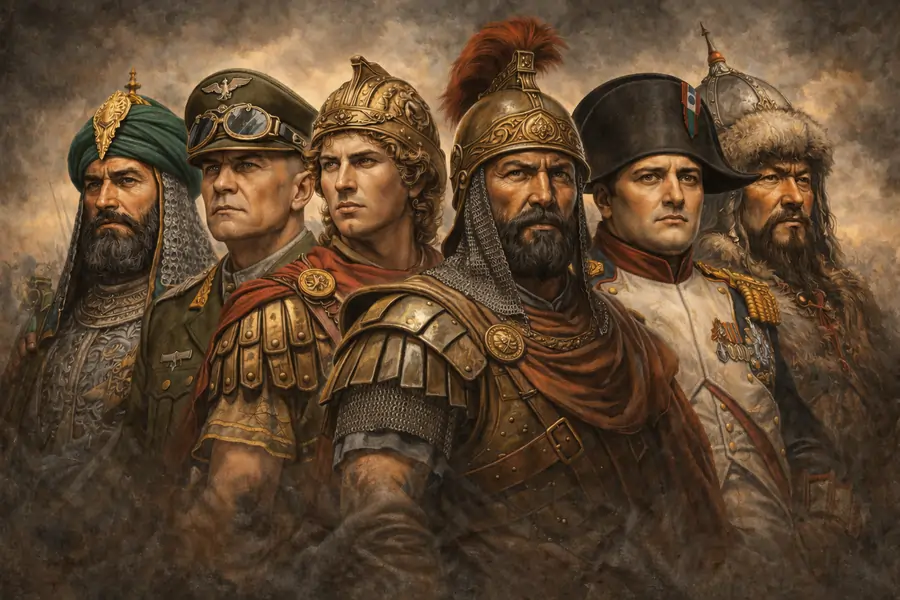
Top 10 Military Commanders of All Time
- Attila the Hun
- Cyrus the Great
- Saladin
- Erwin Rommel
- Robert E. Lee
- Julius Caesar
- Napoleon Bonaparte
- Genghis Khan
- Alexander the Great
- Hannibal Barca
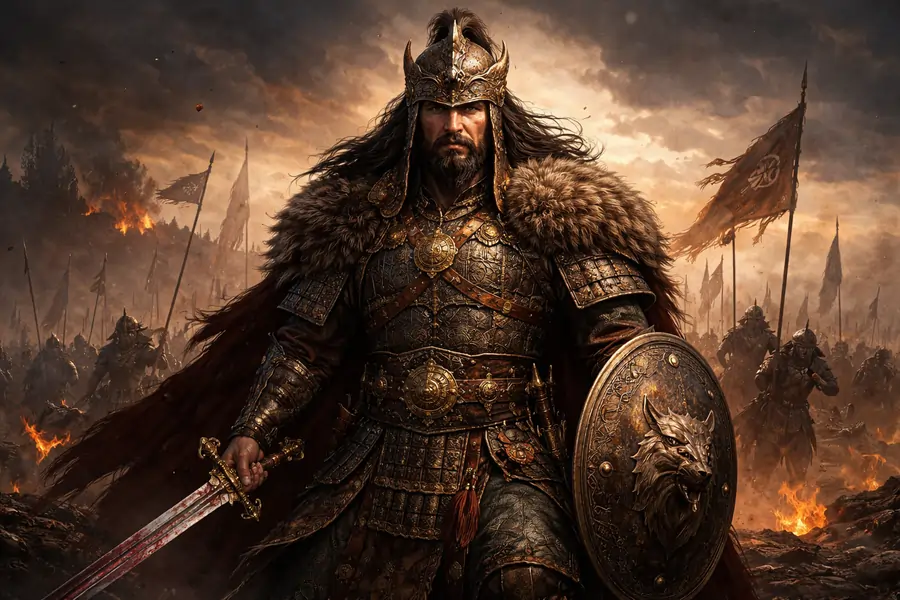
10. Attila the Hun: The Scourge of God
Among the most feared historical military leaders, Attila ruled the Huns from 434 AD to 453 AD. His enemies called him "the Scourge of God." This legendary general terrorized both the Eastern and Western Roman Empire through brilliant cavalry tactics and ruthless efficiency. In 452 AD he invaded Italy and nearly captured Rome itself, withdrawing only after negotiations with Bishop Leo I.
Attila united the tribes of Huns, Ostrogoths, and Alans to form a strong fighting force. He never considered the Romans to be a real threat and ransacked about 70 cities. Attila's army comprised of a large contingent of cavalry which struck the enemy quickly and without mercy. There was no general who wanted to wanted to face the Huns in battle under Attila.
The Huns usually appeared from nowhere and melted away leaving destruction in their path. The Huns were stopped only once during the entire time period Attila was their leader. It was the Battle of the Catalaunian Plains where the combined forces of the Romans and Visigoths stopped the Hun invasion of Italy. This was one of the bloodiest battles in history and its outcome is still debated as a stalemate. Attila died in 453 AD on his wedding night under mysterious circumstances.
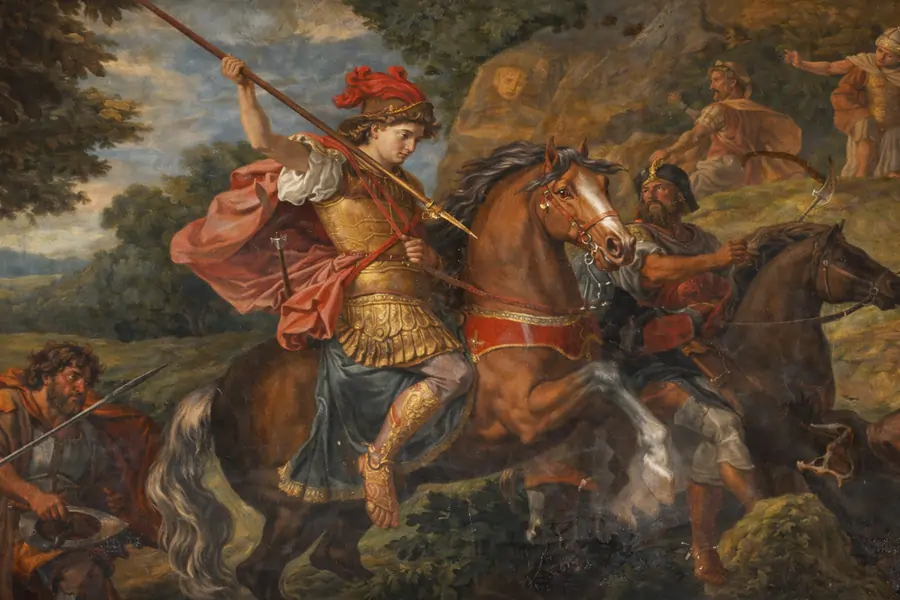
9. Cyrus the Great: Founder of an Empire
Cyrus II of Persia, one of the greatest war strategists of the ancient world, founded the Achaemenid (Persian) Empire. "The King of the four corners of the world" ruled between 559 BC to 530 BC. Under his rule, the Persian empire stretched from the Mediterranean Sea in the west to the Indus River in the east. This famous general in history was recognized for revolutionary achievements in human rights, politics, and military strategy.
The Battle of Thymbra was a decisive battle fought between the Lydian Kingdom and Cyrus the Great. 420,000 troops from the Lydian Kingdom faced off against about 200,000 troops under Cyrus. Despite being outnumbered 2:1, Cyrus utterly defeated the Lydians, and the Persians occupied Lydia.
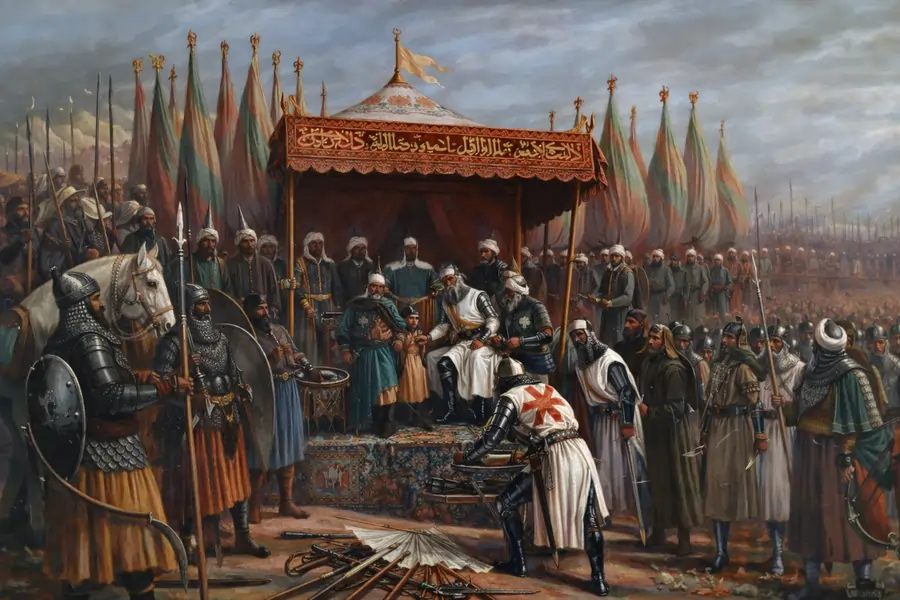
8. Saladin: Legendary General of the Crusades
Saladin or Salah ad-Din was the founder of the Ayyubid dynasty. He ruled the Muslims or Egypt and Syria between 1174 AD and 1193 AD. He led a series of successful campaigns against the Christian Crusaders. He captured Jerusalem on October 2, 1187, ending its nearly 9-decade occupation by the Franks.
Even among his enemies, Saladin was considered as a chivalrous knight known for his fierce struggle against the crusaders and his generosity. His greatest triumph was the Battle of the Horns of Hattin. 20,000 Crusaders under King Guy of Lusignan faced off against about 20,000-30,000 Muslim warriors under Saladin.
The Crusaders marched from their camp under the hot sun to relieve the besieged city of Tiberias. They were constantly harassed by Muslim horse archers and the scorching heat. They finally faced Saladin's army near the Horns of Hattin and were literally annihilated. The piece of the true cross, a holy relic for the Christians was also captured. This directly led to the fall of Jerusalem and other major cities held by the Crusaders in the holy land.
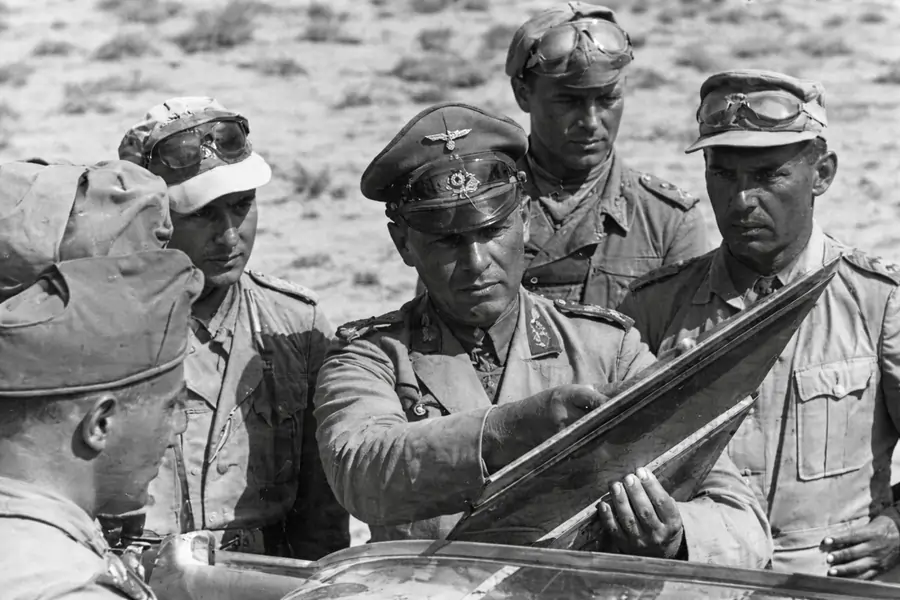
7. Erwin Rommel: The Desert Fox
Erwin Rommel was a Field Marshal of the German Army during World War 2. This famous general in history was given the nickname "The Desert Fox" for his role in the African campaign. He is one of the few German Generals who was respected by the Allies for his chivalry. The North African campaign was referred to as a "war without hate."
Rommel's 7th Panzer division enjoyed great success during the Battle of France. His division crossed 200 miles in just seven days and captured about 100,000 Allied troops. The exact location of Rommel's Panzers was at times not known by the enemy as well as the German headquarters earning the nickname, "The Ghost Divison."
In February 1941, Rommel was appointed the commander of the German troops (The Afrika Korps) in North Africa. It is here that he earned the nickname "The Desert Fox" for his audacious surprise attacks. He almost won the war in North Africa but was stopped by the British at El-Alamein. He committed suicide on October 14th, 1944 after he was charged with the assassination attempt on Hitler.
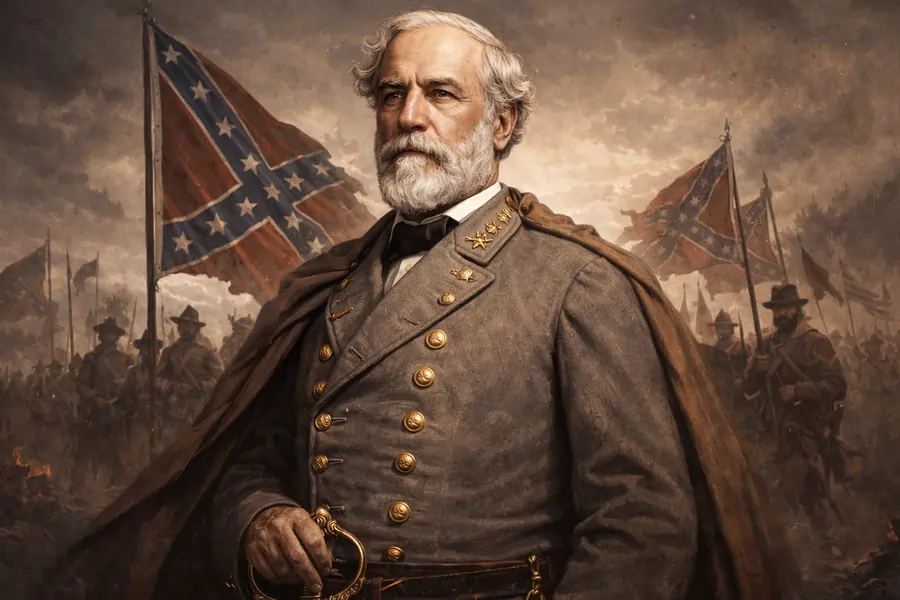
6. Robert E. Lee: Confederate Military Commander
Robert Edward Lee was the commander of the Confederate forces during the American Civil War. This top military commander was initially the Commander of the Army of Northern Virginia which was the most successful of the Southern Armies. In February 1865, Lee was given command of all Southern troops. The Confederate forces under Robert E. Lee continuously handed major defeats for the Union forces.
The Confederate forces were under-equipped and outnumbered. However, under the leadership of Lee, they came out on top every time. The Battle of Chancellorsville was Lee's "perfect battle" where he defeated a much larger Union Army by dividing his troops. Around 130,000 Union troops faced 60,000 Confederates in the battle. Although Lee won this battle, he was not able to prevent Union withdrawal effectively. The Confederates were also not able to replenish their losses.
Lee was used to fighting battles in which he was outnumbered but still came out victorious. His strategic genius was the only thing keeping the Southern States in the war. However, the invasion of the North ended with the Battle of Antietam (September 17, 1862). This was the bloodiest day in the United States history resulting in 22,717 soldiers winding up dead, wounded, or missing. It was a strategic loss for the Confederates and resulted in the Emancipation Proclamation.
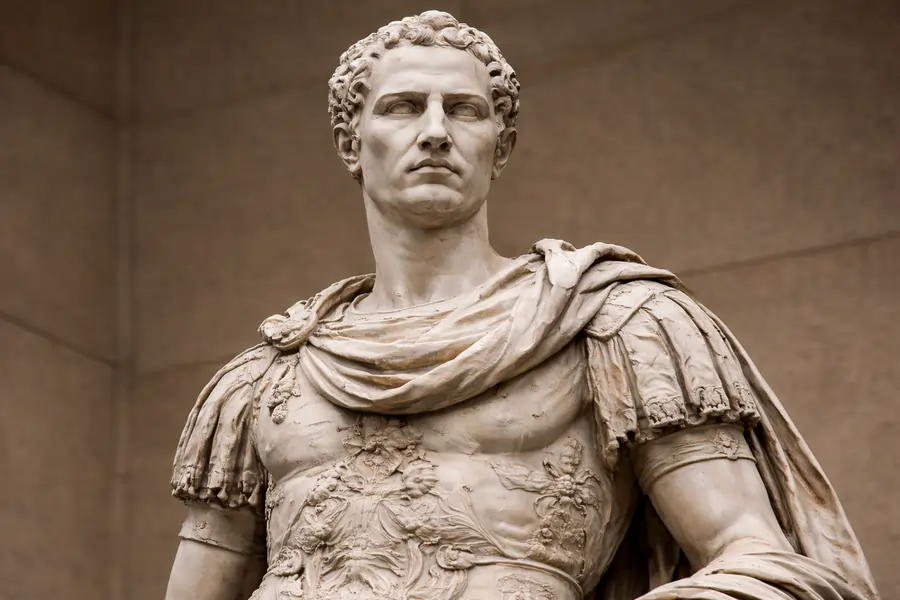
5. Julius Caesar: Rome's Greatest War Strategist
Gaius Julius Caesar was a famous Roman politician and military general who changed the course of Roman history. This legendary general shaped the destiny of the Roman Empire through brilliant military campaigns. The month of "July" was renamed in honor of Caesar. In Rome, the role of a dictator had time restrictions. Caesar abandoned these time restrictions by proclaiming himself a "dictator in perpetuity."
The major military campaigns of Caesar includes the Gallic war and Caesar's civil war. The Gallic war was between Rome under Caesar and the Gallic warriors under Vercingetorix. The Gauls were decisively defeated in the Battle of Alesia. 60,000-75,000 Romans faced off against the garrison of about 80,000 Gauls and a relief force of about 248,000 Gauls.
Caesar ordered the construction of fortifications facing the city as well as another set of palisades facing outside to handle the relief forces. Although outnumbered by the Gauls, the Romans managed to defeat them under the leadership of Caesar. On March 15th, 44 BC Caesar was assassinated by his own countrymen for the radical reforms he made. This event gave rise to the phrase "beware the ides of March," which was famously used in the play Julius Caesar by Shakespeare.
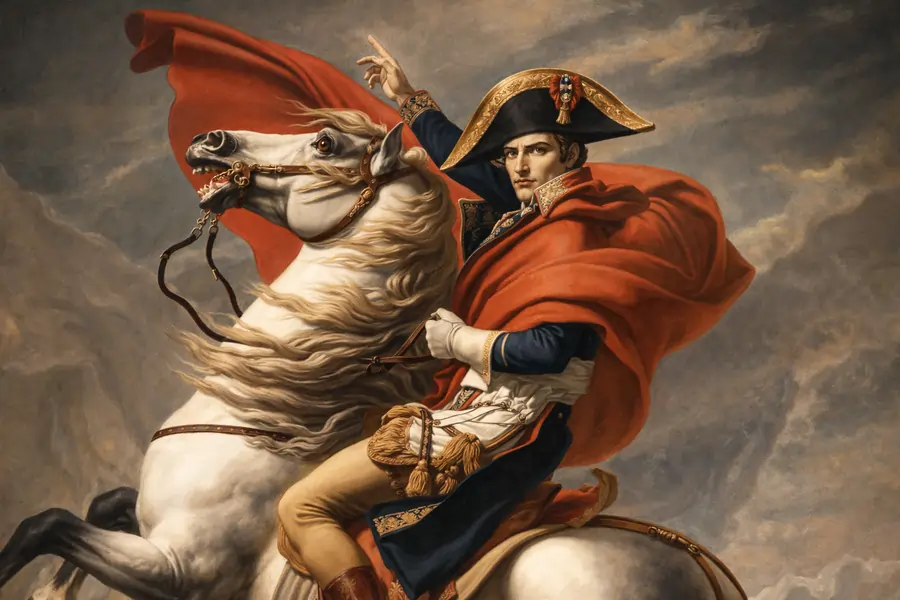
4. Napoleon Bonaparte: Master of Modern Warfare
Napoleon Bonaparte, one of the top military commanders in history, was Emperor of France from 1804 AD to 1814 AD and again for 100 days in 1815. This legendary general rose to prominence during the French Revolution and dominated Europe for more than a decade through innovative military strategy. He fought numerous battles against powerful coalitions and won most of them through tactical brilliance.
Napoleon stood alone against the world and won time and again. His Grand Armee seemed invincible. Napoleon's greatest triumph was the Battle of Austerlitz where 68,000 French troops faced off against 95,000 troops of the Third Coalition comprising of Austria and Russia. This Battle was also known as the "Battle of the Three Emperors."
Although outnumbered, the French came out victorious. Napoleon held negotiations before the battle leading his enemies to think that his army was weaker. He also attacked the allies in their weakest points. The average French troop was also better trained and experienced. Napoleon's dream run came to end on June 18th, 1815 at the Battle of Waterloo.
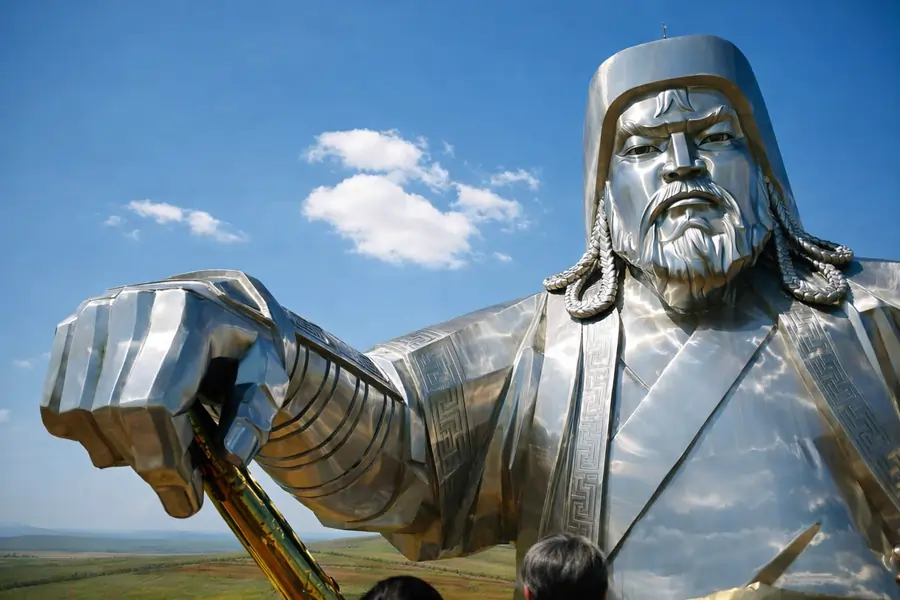
3. Genghis Khan: The Great Khan
Temüjin, born in 1162, founded the Mongol Empire and earned the title "Genghis Khan" meaning "Great Khan." This greatest war strategist united many tribes in northeast Asia into one of the most formidable military forces in history. His revolutionary approach to military strategy history included unparalleled mobility and psychological warfare. The Mongol Empire stretched from the Adriatic Sea to the Pacific coast of China through campaigns against China, Persia, and Qara Khitai.
Genghis Khan was known for his brutality and ruthlessness. His army was a force to be reckoned with. Mongol horse archers were expertly trained to shoot even while moving away from the target. They relied on hit-and-run tactics and laid ambushes for enemy troops. Advanced tactics and leadership enabled the Mongols to overpower powerful adversaries like the Khwarazmian Empire.
The Mongols also employed psychological warfare. If a city refused to surrender, they would utterly destroy it but leave a few survivors to spread terror. The captured generals will then be executed by pouring molten silver over their eyes and ears! Despite all this, the Great Khan was also generous. He banned the kidnapping of women, adopted a writing system, conducted a regular census and allowed freedom of religion.
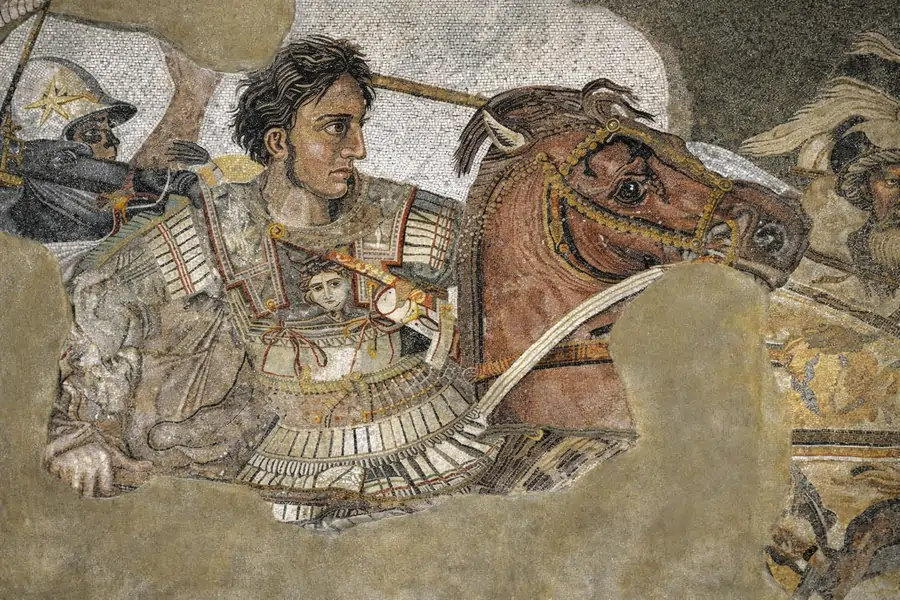
2. Alexander the Great: Undefeated Conqueror
Alexander III of Macedon stands among the most famous generals in history, truly worthy of the title "Alexander the Great." The son of King Philip II of Macedonia, he inherited highly trained and motivated troops. Under his brilliant leadership—combining tactical genius with personal courage—they conquered half of the known world. His Empire stretched from Greece to Northwestern India, a testament to his status as one of the greatest military generals in history.
Alexander was a brave and daring warrior. He used to get into the mind of his enemies and predict their actions to counter them. He would also fight on the front lines with his troops and be in mortal danger which earned the trust and respect of his men. Some would say that he was reckless, but it paid off in his battles as he had never lost a single major battle in his life.
The Battle of Gaugamela showed the true military genius of Alexander. 47,000 Macedonians under Alexander faced off against 120,000 Persian troops under Darius III. Alexander's left flank under Parmenio was purposely weakened to allow the Persians to concentrate their attacks. The infantry was arrayed at a 45-degree angle to tempt the Persian cavalry to attack. The Macedonian infantry held on and since so much of the Persians were committed to Alexander's left flank, the Persian center was left vulnerable.
Alexander was waiting for this opportunity and charged his cavalry through the gaps in the center. Seeing this, Darius fled the battlefield which left his troops in disarray. Alexander, however, was forced to turn back to help Parmenio as his troops were hard pressed. This, however, sealed the victory for the Macedonians. The Macedonians lost 700 men whereas the Persians lost about 40,000.
1. Hannibal Barca: Rome's greatest enemy
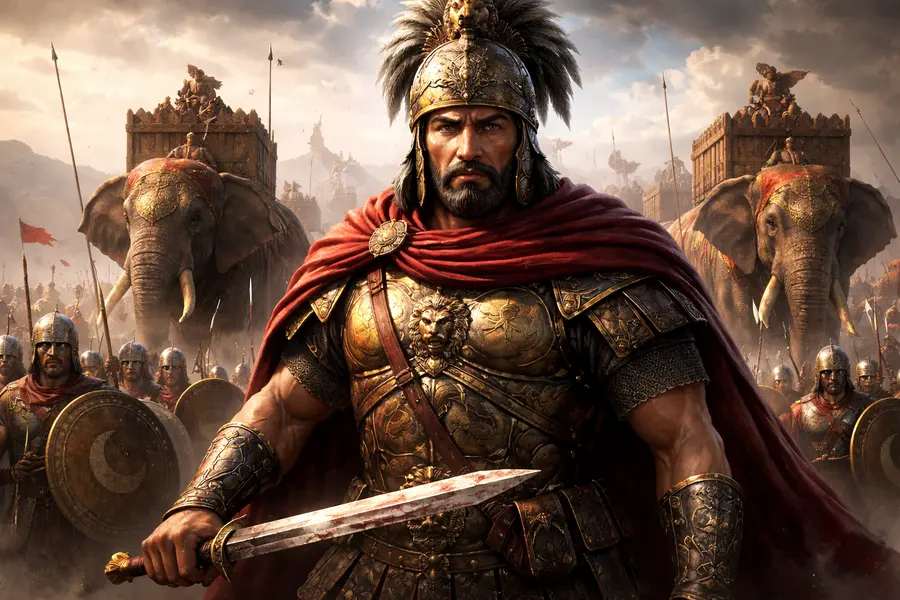
Hannibal Barca, the Carthaginian general during the Second Punic War, is widely regarded as the greatest of all top military commanders. This legendary general's tactical brilliance at Cannae remains studied in military academies worldwide. The son of Hamilcar Barca, the leading Carthaginian commander during the First Punic War, Hannibal swore a blood oath to his father that he would forever be Rome's enemy. He kept his oath and revolutionized military strategy through his campaigns.
"I swear so soon as age will permit...I will use fire and steel to arrest the destiny of Rome."
Rome had won the First Punic War, and this left Carthage in a tight spot. Hannibal began building his army by campaigning in Spain. Conflict with Rome was inevitable, and soon Hannibal was facing the Romans in the Second Punic War. Rome had control over the seas, and so a naval invasion was out of the question. So Hannibal did the unthinkable.
He took his army of 38,000 soldiers, 8,000 horsemen, and 38 elephants on a journey across the Alps. The journey was harsh, and only about 20,000 infantry, 4,000 cavalry, and a few elephants survived. But the Romans were caught off guard, and the Carthaginian army was free to rampage across Italy. Hannibal was also able to get reinforcements from states that defected to him.
Hannibal was able to score major victories in the Battle of Trebia and Battle of Lake Trasimene. The Romans faced heavy casualties reaching close to 30,000 in each of these battles. Hannibal needed to be dealt with, or Rome was sure to fall. In 216 BC, Rome raised the largest army she had ever mustered. Some say the number of troops was close to 100,000, but a realistic number would be around 80,000.
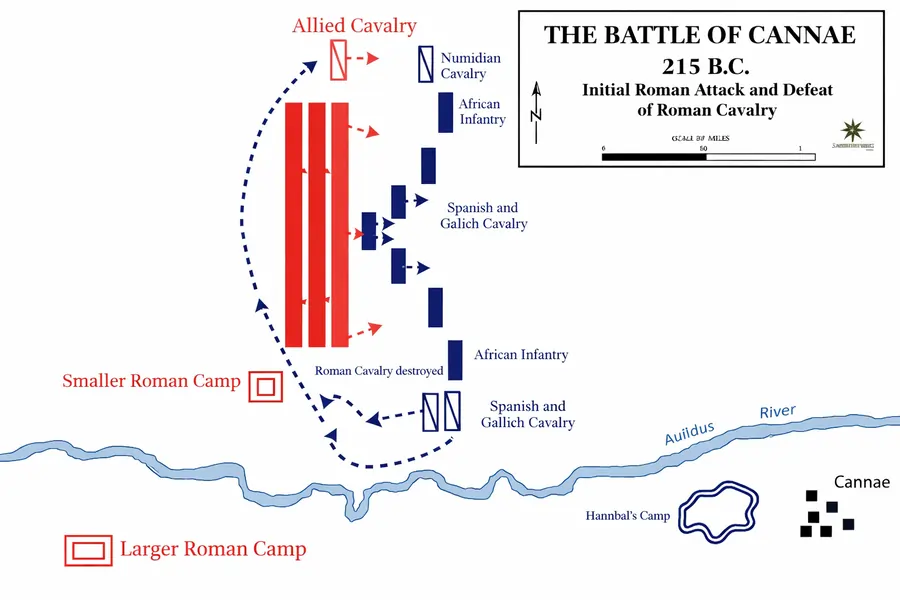
The Battle of Cannae was Hannibal's greatest masterpiece. 50,000 Carthaginian troops under Hannibal faced 86,400 Roman troops led by Paullus and Varro. Despite being heavily outnumbered, Hannibal fought the battle and devised a formation that would allow him to win. Hannibal deployed his troops in the form of a crescent with his weakest troops in the center and his strongest troops in the flanks.
As the Battle began, the Roman troops struck hard and pushed the troops in Hannibal's center back. Sensing blood, they went all in and pushed forward. Hannibal's plan worked as expected. His center bent under the weight of the Roman attack but did not break. As the center slowly retreated, the Carthaginian flanks encircled the Roman troops. The Carthaginian cavalry chased off the Roman cavalry and returned to hit the Romans in the rear completely encircling them.
The very first double-envelopment tactic was now complete. Military generals hundreds of years later would still learn from this battle. The Romans were completely surrounded and unable to even move or fight. The slaughter continued for hours and at the end around 67,500 Romans were either killed or captured. Rome had lost one-fifth of the entire population of male citizens (150,000) over 17 years in Hannibal's campaign.
Bonus: Khālid ibn al-Walīd - The Sword of God
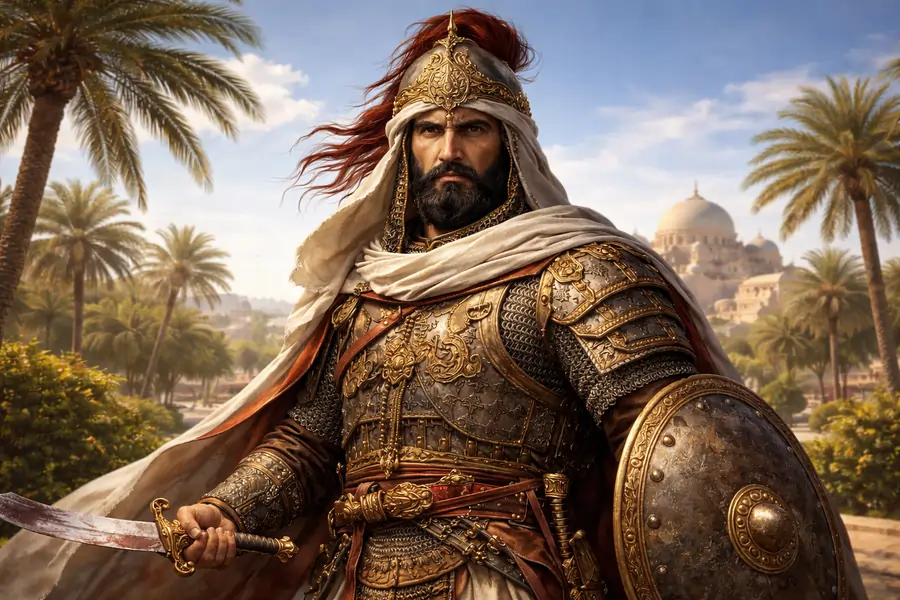
Khālid ibn al-Walīd was an Arab military commander under the service of prophet Muhammad, the caliphs Abu Bakr and Umar. This legendary general played a leading role in the Ridda wars and the early Muslim conquest of Iraq and Syria. Although he initially opposed Muhammad, he later converted to Islam in 627AD. Muhammad then appointed Khalid as commander.
Muhammad bestowed the title 'Sayf Allah' to Khalid. 'Sayf Allah' means the sword of God. He earned a reputation for being an excellent military strategist. It was under his command that the Islamic expansion was hugely successful. He did not follow orders directly but acted independently.
"He simply defeated whoever was there to be defeated."
Khalid's success put fear in the hearts of many. His military fame disturbed many people. Umar feared that Khalid's success would develop into a personality cult. Umar dismissed Khalid as the troops had become so captivated by his illusion that they put more trust in Khalid rather than in God.
Frequently Asked Questions
Who is considered the greatest military general of all time?
Hannibal Barca is widely considered the greatest due to unparalleled tactical genius. His Battle of Cannae (216 BC) used the first double-envelopment, defeating a Roman army twice his size. His audacious Alpine crossing with elephants showed extraordinary vision. He remained undefeated in Italy for fifteen years despite being outnumbered and without reinforcements. His achievements against mighty Rome under disadvantageous circumstances solidify his position as history's supreme commander.
What made Alexander the Great such a successful military commander?
Alexander's success stemmed from tactical brilliance, personal courage, innovation, and inspirational leadership. Never losing a major battle, he conquered from Greece to India by age 32. He fought alongside troops, earning loyalty through shared danger. His tactical innovations included effective Macedonian phalanx with heavy cavalry. At Gaugamela, despite facing forces three times larger, his genius exploited enemy weaknesses. Possessed uncanny ability to read battlefields and adapt strategies. His charisma inspired fierce loyalty.
How did Napoleon Bonaparte change modern warfare?
Napoleon revolutionized warfare through innovations defining military strategy for centuries. He created self-sufficient corps providing unprecedented flexibility, mastered rapid movement and force concentration to defeat larger armies, and pioneered artillery as decisive offensive weapon. His strategic genius identified enemy weaknesses. Established military staff systems still used today, introduced merit-based promotion. His tactics at Austerlitz demonstrated deception and attacking weak points. Napoleon's military maxims continue influencing academies worldwide, with campaigns essential for understanding operational art.
Why did Hannibal Barca fail to defeat Rome despite winning major battles?
Despite tactical mastery and victories at Trebia, Lake Trasimene, and Cannae, Hannibal failed because Carthage sent inadequate reinforcements, leaving him isolated. Rome's Italian allies remained loyal, denying him manpower. He lacked siege equipment to assault Rome's fortifications. Rome refused negotiation, displaying extraordinary resilience by raising new armies. Romans adapted under Fabius Maximus, using attrition. Rome attacked Carthaginian territories, forcing resource diversion. Scipio Africanus learned Hannibal's tactics and defeated him at Zama.
What qualities made Genghis Khan such an effective military leader?
Genghis Khan's effectiveness stemmed from revolutionary organizational skills, innovative tactics, and psychological warfare mastery. He transformed Mongolian tribes into history's most formidable military through strict discipline, meritocracy, and loyalty rewards. Innovations included decimal organization, sophisticated communications, and combined arms tactics. Unmatched mobility using multiple horses per rider allowed surprise. Employed psychological warfare offering surrender or destruction. Despite myths, Mongol armies often won while outnumbered through superior tactics and leadership.
How did Julius Caesar become Rome's greatest military commander?
Caesar became Rome's greatest commander through tactical brilliance, strategic vision, charisma, and military reforms. His Gallic conquest demonstrated ability to campaign in difficult terrain against numerous enemies while building loyal legions. At Alesia, his outnumbered forces defeated both besieged and relief armies through brilliant engineering. Possessed exceptional operational speed, achieving strategic surprise. Fought alongside soldiers, earning extraordinary loyalty. His military writing reveals methodical planning while adapting to circumstances. Revolutionized Roman engineering. His political-military abilities, bravery, and calculated risks made him transformative.