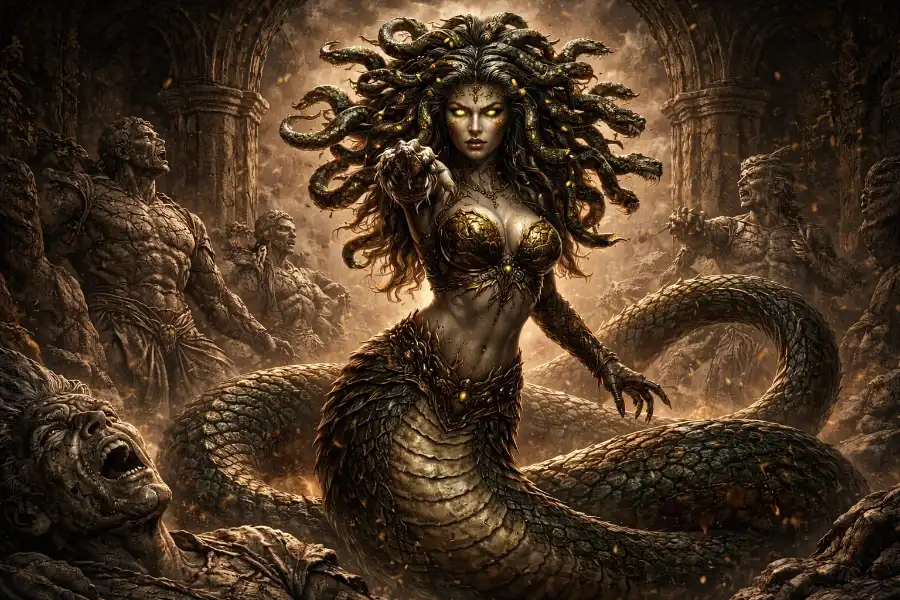
Medusa is often remembered as a monster, but Greek mythology tells a far more tragic story of injustice, punishment, and transformation.
Table of Contents
Who was Medusa?
In Greek Mythology, Medusa was one of three monstrous sisters - Stheno, Euryale and Medusa. They were the daughters of Phorcys, a primordial sea god, and Ceto, a sea goddess. Medusa was the only mortal of the three Gorgon sisters and was eventually killed by the hero Perseus. Medusa is often described as beautiful compared to her Gorgon sisters; some accounts portray her as a priestess of Athena before her transformation.
The Gorgons of Greek Mythology
The three Gorgons described in Greek Mythology were,
- Stheno - meaning mighty and strong,
- Euryale - meaning far springer,
- Medusa - meaning the Queen or Guardian
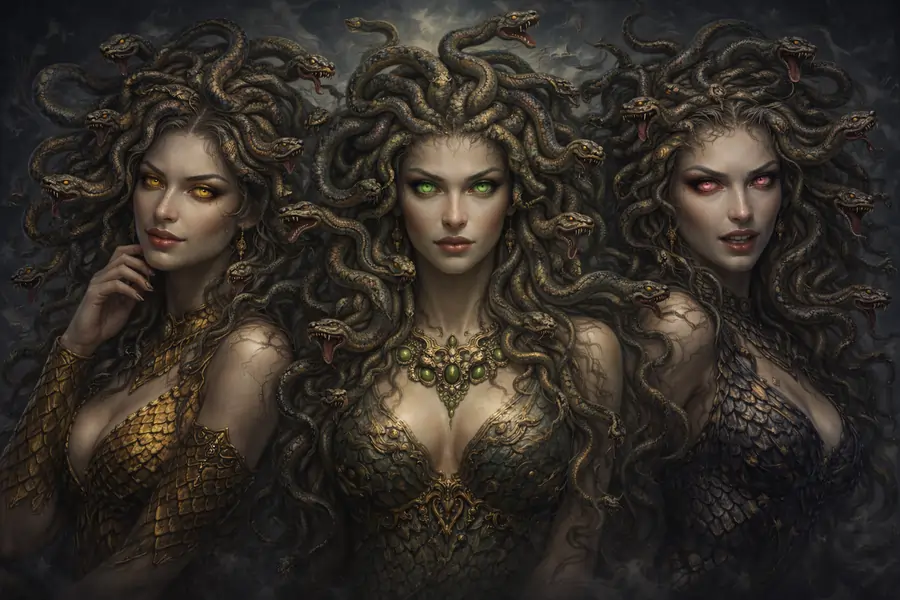
Stheno and Euryale were considered to be hideous monsters with hair made of venomous snakes, scaly skin, long tongues, boar-like fangs and golden wings. They were also immortal and indestructible. According to different versions of Greek Mythology there was only one Gorgon (according to Homer), three Gorgons where Medusa was also born as a hideous mortal monster (according to Hesiod) and in Ovid's account Medusa is born a human girl and a priestess to Athena.
Athena's Curse and Poseidon's Role
According to Ovid's version, the mortal Medusa was a young girl whose beauty and charm was noticed by Poseidon, the god of the seas. To her misfortune, Poseidon raped Medusa inside a temple of Athena. Regardless of the exact circumstances, the act angered Athena greatly and she transformed Medusa into a hideous monster capable of turning men to stone by looking at her. This episode—often referenced as Athena curse Medusa—is central to the Medusa tragic story and to modern discussions about blame and divine power.
Perseus and Death of Medusa
King Polydectes had given Perseus an impossible task to save his mother Danae. The king had fallen in love with Danae and wanted to get rid of Perseus. The task was to bring the head of Medusa. Since Perseus was the son of Zeus, he was given gifts by the gods to help him accomplish his task,
- Cap of invisibility - a gift from Hades, the god of the underworld,
- Winged sandals and a harpe (a curved sword) - gifts from Hermes, the messenger god,
- Polished shield - a gift from Athena, the goddess of wisdom,
- A magical bag - a gift from the nymphs/Hesperides to carry the head of Medusa,
Perseus then located Medusa's cave and found her sleeping. He slowly moved forward to avoid waking her and used the polished shield given by Athena to view Medusa by reflection, thereby avoiding her petrifying gaze. Once close enough he used his harpe to slice off her head and placed it in the magical bag. After Medusa's death her sisters Stheno and Euryale chased Perseus in vengeance, but they could not catch him while he wore Hades' cap.

The Birth of Pegasus
Medusa was pregnant with Poseidon's children when she was beheaded by Perseus. When he took off Medusa's head, two children came out of her opening - Pegasus the winged horse and Chrysaor. Chrysaor would become the father of Geryon, the three-headed giant who was later killed by Hercules in one of his twelve labours. Medusa's blood was also considered powerful: blood from one side was said to bring life, from the other to be poisonous. When Perseus passed over Libya, a few drops of Medusa's blood were said to have transformed into snakes.
The Cruel Fate of Medusa
Medusa was unfortunate enough to be raped by Poseidon and defiled against her will. She did not get justice but was instead punished by Athena for fraternizing in her temple. The once-beautiful maiden was turned into a hideous monster feared by everyone. Her fate continued after death: her head retained its powers even in death.
Cassiopeia promised Perseus that he could marry her daughter Andromeda if he killed the sea monster ravaging their country. Perseus used Medusa's head to kill the sea monster and rescue Andromeda, the Ethiopian princess. When Cassiopeia did not honor her promise and threatened Perseus with armed suitors, Perseus used Medusa's head against them. Later, Medusa's head was given to Athena who placed it on her aegis, a shield or breastplate.
Modern Interpretation and Symbolism of Medusa
Medusa symbolism feminism is a strong modern interpretation. The innocent priestess was assaulted and blamed, and her transformation into a monster is often read as victim-blaming. Her gaze, capable of turning men to stone, is interpreted by some as a defensive mechanism. Contemporary artists and writers reclaim Medusa as a symbol of survival, defiance, and resilience.
Related Articles

Frequently Asked Questions
Was Medusa always a monster?
No. Many accounts—especially Ovid's—present Medusa as a beautiful mortal or priestess who was later transformed into a Gorgon by Athena.
Why did Athena curse Medusa?
Different sources give different reasons. In Ovid's telling, Athena punishes Medusa after Poseidon raped her in Athena's temple. Interpretations vary: some see the punishment as unjust victim-blaming, while others emphasize divine retribution for the temple's desecration.
How are Perseus and Medusa connected?
The hero Perseus beheaded Medusa as part of a quest. Using divine tools—including a mirrored shield from Athena—Perseus avoided Medusa's lethal gaze and brought back her head, which retained its power even after her death.
Is Pegasus really born from Medusa?
Yes. In many versions of the myth the winged horse Pegasus springs from Medusa's blood at the time of her beheading; this forms the core of the Pegasus birth myth.
What does Medusa represent today?
Medusa has become a complex cultural symbol: a cautionary tale, a warning about unchecked power, and a potent emblem in feminist discourse representing survival, rage, and reclaimed agency.