Dive into one of history's most significant events that shaped the modern world. Explore the causes, key battles, influential figures, and lasting impact of World War II. From the rise of fascism to the atomic age, discover the stories that changed the course of human history.
Articles in This Category
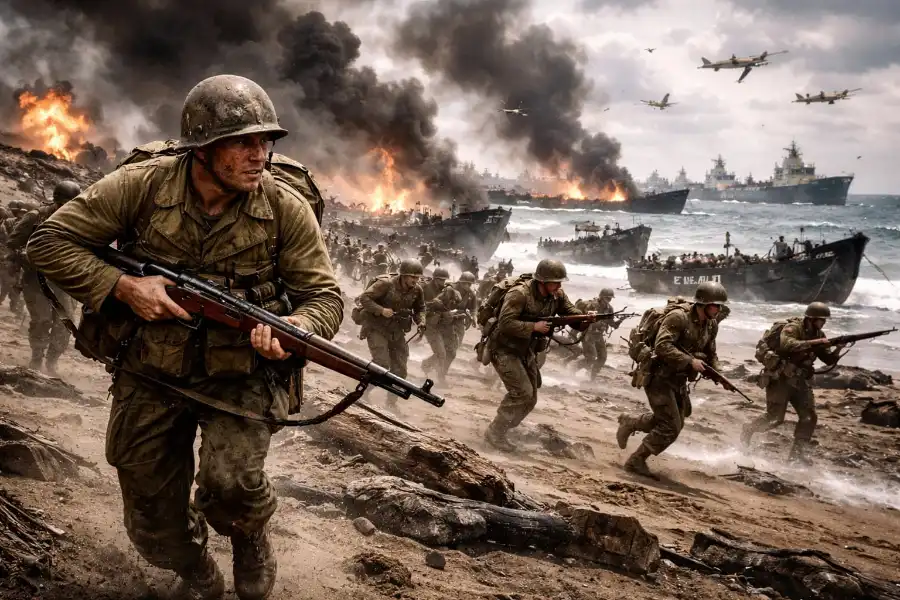
How America Turned the Tide in WW2: From Pearl Harbor to Global Superpower
Explore America's role in World War II, why the United States entered the war, key battles, and how WWII reshaped global history.
Read Article →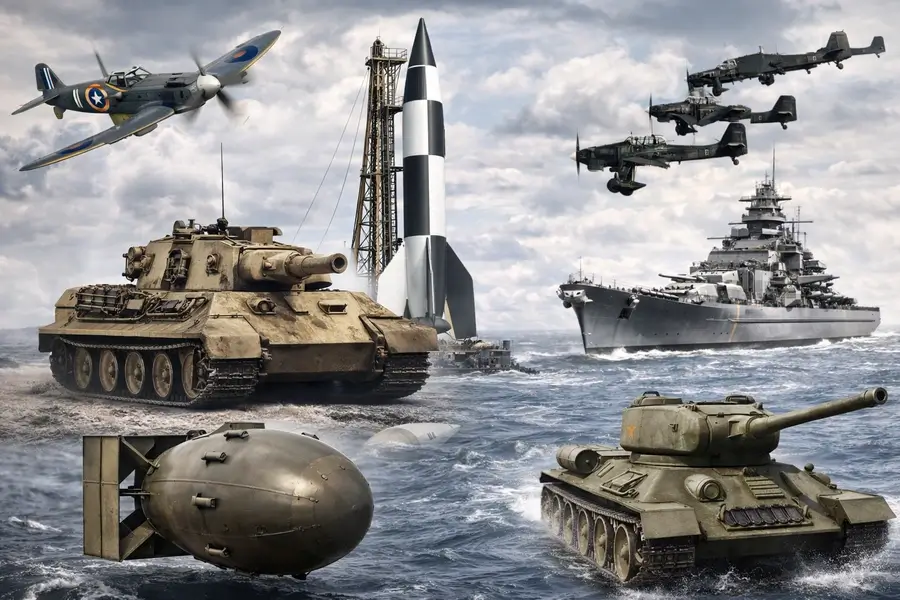
10 WW2 Weapons That Changed Warfare Forever: From Tiger Tanks to the Atomic Bomb
Explore the most iconic World War II weapons—from Tiger tanks and Spitfires to radar, U-boats, and the atomic bomb—that reshaped modern warfare.
Read Article →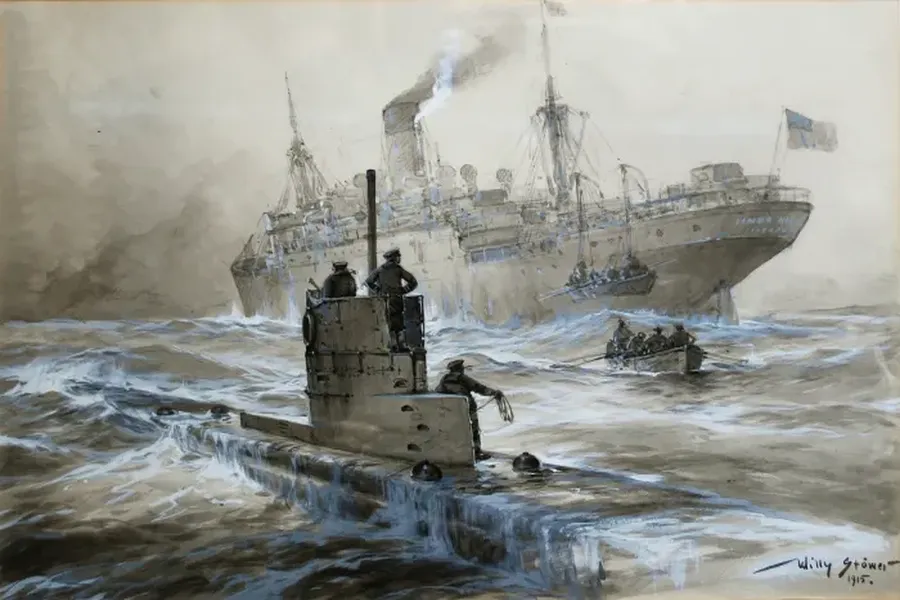
Unrestricted Submarine Warfare Explained: German U-Boats and Wolf Packs
What was unrestricted submarine warfare? Learn why German U-boats used wolf pack tactics in WW1 and WW2, the Lusitania, and the Laconia incident.
Read Article →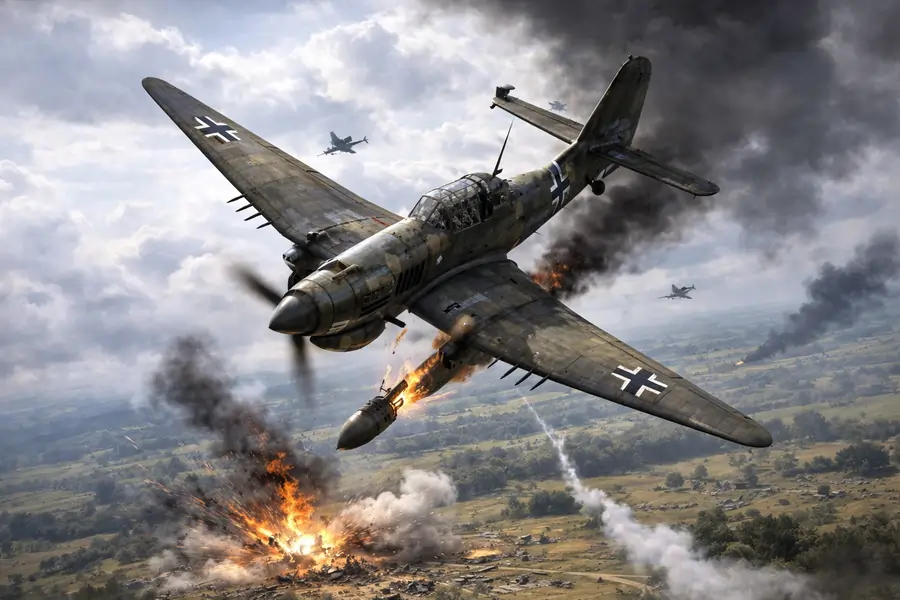
What Was Blitzkrieg? The WW2 Tactic That Shocked the World
What was Blitzkrieg and why was it so effective? Learn how German tanks, air power, and speed revolutionized warfare in World War II.
Read Article →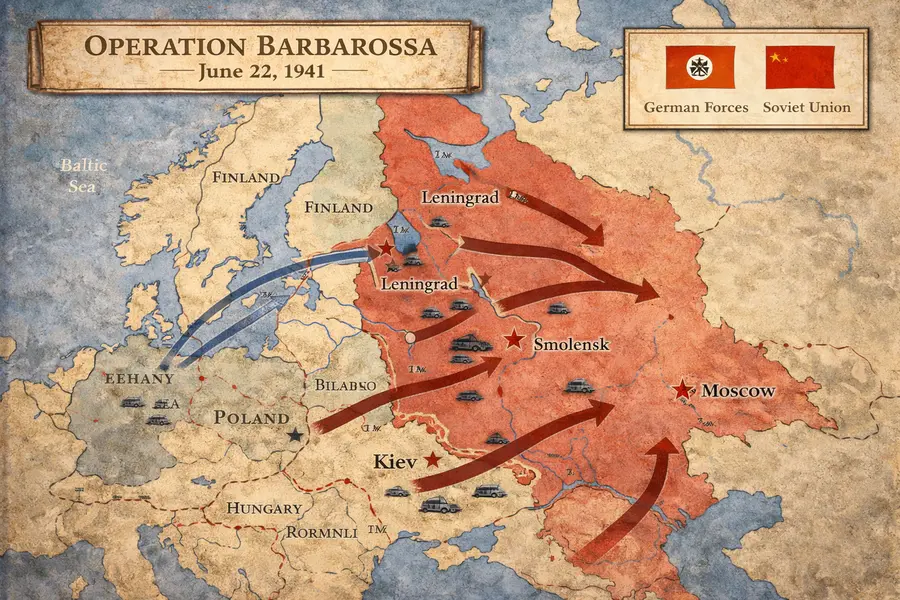
Hitler's Fatal Mistake: Why Invading the Soviet Union Doomed Nazi Germany (Operation Barbarossa)
Why did Hitler invade the Soviet Union in 1941? Explore Operation Barbarossa, Nazi strategy, ideology, resources, and the mistakes that doomed Germany...
Read Article →World War II was not just the largest conflict in human history—it was a moment when the modern world was violently reshaped.
It was a war fought not only on battlefields, but in factories, oceans, skies, homes, and occupied cities. It involved soldiers and civilians alike, generals and engineers, resistance fighters and ordinary people forced to make impossible choices. By the time it ended, borders had shifted, empires had collapsed, and the course of global history had been permanently altered.
This section of Myth and Memory explores World War II not as a single, unified story, but as a collection of interconnected struggles—strategic, technological, ideological, and deeply human.
A War of Speed, Scale, and Shock
One of the defining features of World War II was how quickly it shattered old assumptions about warfare. Early in the conflict, traditional ideas of slow mobilization and static defenses proved dangerously outdated. Speed, coordination, and surprise became decisive factors. Entire nations were overwhelmed in weeks rather than years, not because they lacked courage, but because warfare itself had changed.
The war introduced a new rhythm—fast-moving offensives, sudden collapses, and constant adaptation. Commanders were forced to think in terms of mobility, supply lines, air support, and communication on a scale never seen before. World War II showed that modern war would no longer wait for anyone to catch up.
Strategy Beyond the Battlefield
World War II was as much a war of planning and logistics as it was of direct combat. Behind every offensive were months of preparation: fuel stockpiles, transport networks, industrial output, intelligence gathering, and coordination between land, sea, and air forces. Victory depended not only on bravery, but on whether nations could sustain prolonged conflict without collapsing internally.
This is why strategies like rapid mechanized warfare, long-term economic attrition, and total industrial mobilization played such a crucial role. The outcome of many campaigns was decided far from the front lines—in shipyards, factories, and planning rooms. Understanding World War II means understanding how systems, not just soldiers, fought the war.
War Beneath the Waves
While massive battles captured headlines, much of World War II unfolded quietly beneath the oceans. Submarine warfare became a critical struggle for control of supply routes. Merchant ships carrying food, fuel, and weapons were just as important as tanks and aircraft. A nation cut off from its supplies could be defeated without ever losing a major battle.
This underwater war was tense, isolating, and psychologically brutal. Crews operated in confined spaces for weeks at a time, knowing that a single mistake—or a hidden enemy—could mean death with no warning. Submarine warfare highlights one of World War II's most sobering realities: survival often depended on unseen battles far from public attention.
Total War and the Civilian Experience
World War II erased the line between military and civilian life. Cities became targets. Industries became battlefields. Civilians were expected to endure rationing, blackouts, air raids, displacement, and constant uncertainty. For many, the war was not something that happened "over there"—it was something that arrived at their doorstep.
In occupied territories, daily life became a balancing act between survival and resistance. Ordinary people faced moral dilemmas that had no clear answers: comply to protect family, resist and risk execution, or flee and lose everything. This category does not treat civilians as background figures. Their experiences are central to understanding the true cost of the war.
America's Transformation Through War
For the United States, World War II marked a turning point. The war pulled America fully onto the global stage, transforming it from a nation emerging from economic hardship into an industrial and military powerhouse. Factories ran day and night. Millions were mobilized. Entire communities were reshaped by the demands of war production.
America's involvement in World War II was not only military—it was social and cultural. The war changed attitudes toward technology, global responsibility, and national identity. It also exposed contradictions, including racial inequality and internal tensions, even as the nation fought abroad. Understanding America in World War II means understanding how war reshapes a society from within.
The Eastern Front and the Scale of Destruction
No part of World War II was as vast or as devastating as the fighting in Eastern Europe. This was warfare on an almost unimaginable scale—massive armies, brutal winters, scorched-earth tactics, and staggering human loss. Battles here were not just about territory; they were ideological struggles where compromise was often impossible.
The Eastern Front demonstrates how World War II became a war of annihilation in certain regions, where survival itself was uncertain and the rules of warfare collapsed under extreme conditions. It serves as a reminder that statistics can never fully capture the human suffering behind them.
Weapons That Defined an Era
World War II was also a turning point in military technology. Weapons developed during the war changed how battles were fought—and how future wars would be imagined. Tanks became faster and deadlier. Aircraft dominated the skies. Automatic weapons, radar, rockets, and advanced naval vessels redefined combat.
But these weapons were not just tools; they were symbols of industrial power and scientific ambition. The race to innovate was relentless, and failure to keep pace often meant defeat. By studying iconic World War II weapons, we gain insight into how technology and warfare became inseparable—and how innovation can accelerate both victory and destruction.
Leadership, Choice, and Consequence
World War II was shaped by individuals as much as by systems. Political leaders, generals, and planners made decisions that affected millions of lives. Some choices were calculated and deliberate. Others were rushed, flawed, or driven by ideology rather than reality.
This category examines leadership not through hero worship, but through consequence. What happens when leaders misjudge their enemies? When ideology overrides strategy? When ambition blinds judgment? World War II offers countless lessons about power, responsibility, and the cost of error.