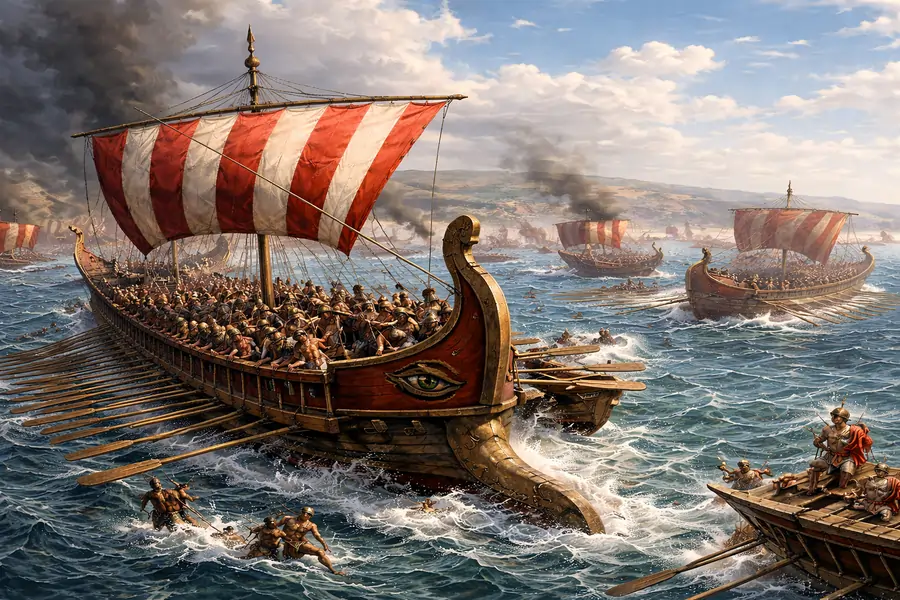
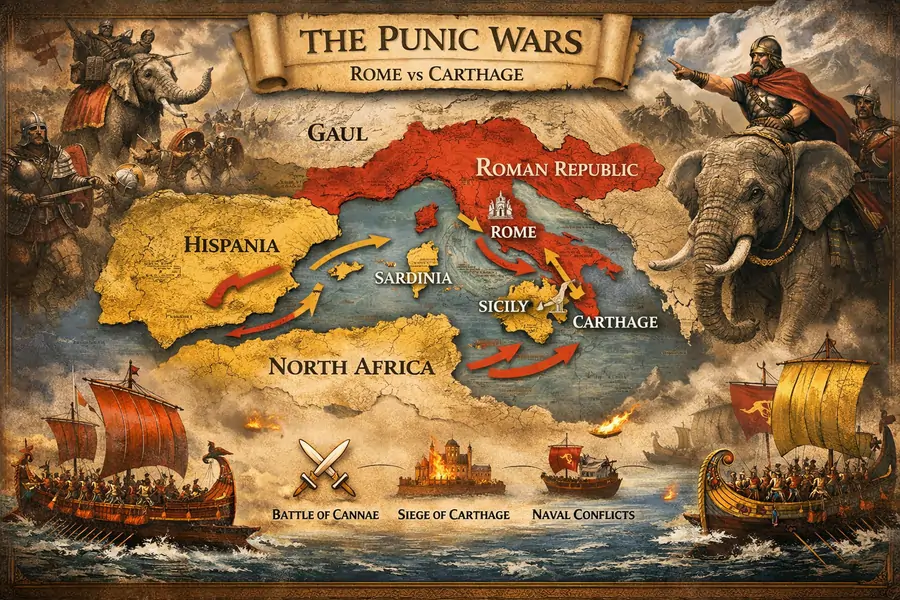
The First Punic War (264-241 BC) represents a pivotal chapter in Punic Wars history—the first monumental clash between Rome vs Carthage for supremacy over the Mediterranean. This 23-year conflict forced Rome to revolutionize its approach to warfare, transforming from a purely land-based power into a naval empire through innovations in Roman naval warfare. The struggle for Sicily and Mediterranean dominance would reshape both civilizations and establish Rome's path to becoming the ancient world's superpower.
Rome vs Carthage was truly a clash of titans. Both powers dominated the Mediterranean during the 3rd century BC, but with vastly different strengths. The term "Punic" derives from the Latin "Punicus" meaning "Phoenician," referencing Carthage's ancestral origins. The Carthaginian navy ruled the seas with centuries of maritime expertise, while Rome commanded the most disciplined land army of the ancient world. This fundamental asymmetry would define the entire conflict and force unprecedented innovation.
Table of Contents
Origins of the First Punic War: The Messina Incident
The First Punic War was caused by a dispute over the control of the islands of Corsica and Sicily. These two islands were strategically important to exert control over the Mediterranean. In 264BC the Mamertini, a band of mercenaries captured the town of Messina in Sicily. They were then besieged by Hieron II of Syracuse. The Mamertini in desperation called on the Romans as well as Carthaginians for help. It was the Carthaginians who arrived first and made a deal with Hieron. This however, did not prevent the Romans from trying their luck. They eventually got a foothold on the city after the Carthaginians were forced to withdraw. This act of aggression now started a war with Carthage.
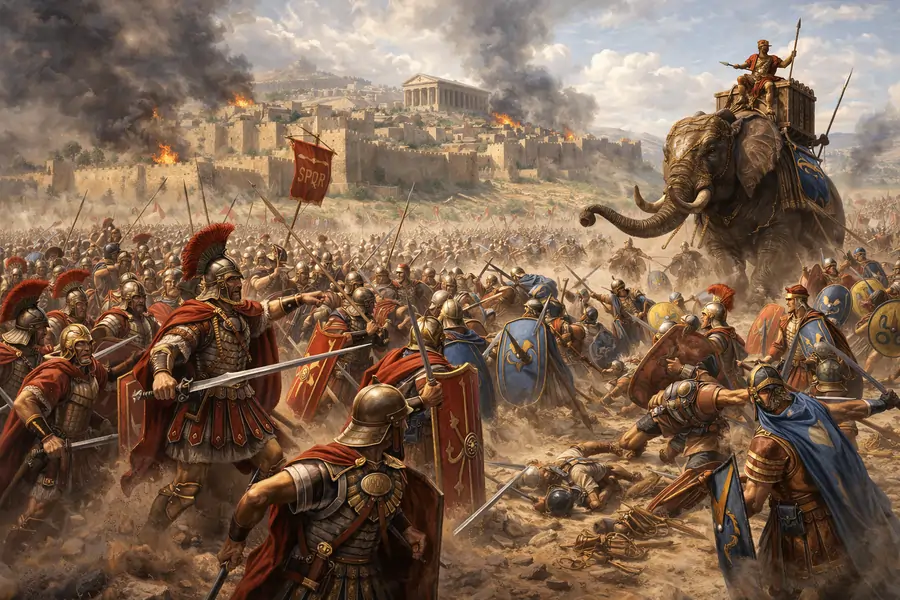
Battle of Agrigentum: Rome's First Major Victory
The Battle of Agrigentum in 262 BC marked a crucial turning point in the early stages of Rome vs Carthage. After Carthage and Syracuse mounted a joint attack on Messana that was repelled by the Romans, Rome forced Syracuse to sue for peace and become their ally in 263 BC. The Romans then laid siege to Carthage's main Sicilian base at Agrigentum. A large Carthaginian relief force arrived but was decisively defeated by Roman legions. The Carthaginians lost 3,000 infantry, 200 cavalry, and 8 war elephants. Despite their victory, the Romans suffered heavily during the siege—losing one-third of their army (30,000 infantry and 540 cavalry). The Carthaginian garrison inside Agrigentum also managed to escape by filling Roman trenches with straw. While Rome captured the city, the incomplete destruction of Carthaginian forces foreshadowed the long struggle ahead.
Roman Naval Warfare vs Carthaginian Navy: The Strategic Challenge
The fundamental challenge in this chapter of Punic Wars history was the stark contrast between Roman and Carthaginian strengths. Rome's citizen-soldiers formed the most disciplined land army of the ancient world, with mandatory military service creating experienced legions. The Carthaginian navy, however, dominated the Mediterranean seas. Their quinqueremes—the battleships of the ancient era—were crewed by expert Phoenician sailors with centuries of maritime tradition. This created an extended stalemate: Rome controlled Sicily's interior while the Carthaginian navy controlled the coasts and supply routes. Victory for either side would require overcoming their fundamental weakness.
The Corvus: Revolutionizing Naval Warfare
Roman naval warfare began with a critical disadvantage. The Romans initially lacked expertise in building large warships like the quinquereme. They reverse-engineered a captured Carthaginian vessel to construct their own fleet, but building ships was only half the battle. Roman sailors couldn't match the Carthaginian navy's centuries of experience in traditional naval tactics—ramming enemy vessels and shearing off oars with precise maneuvering. Rome needed a revolutionary approach to level the playing field.
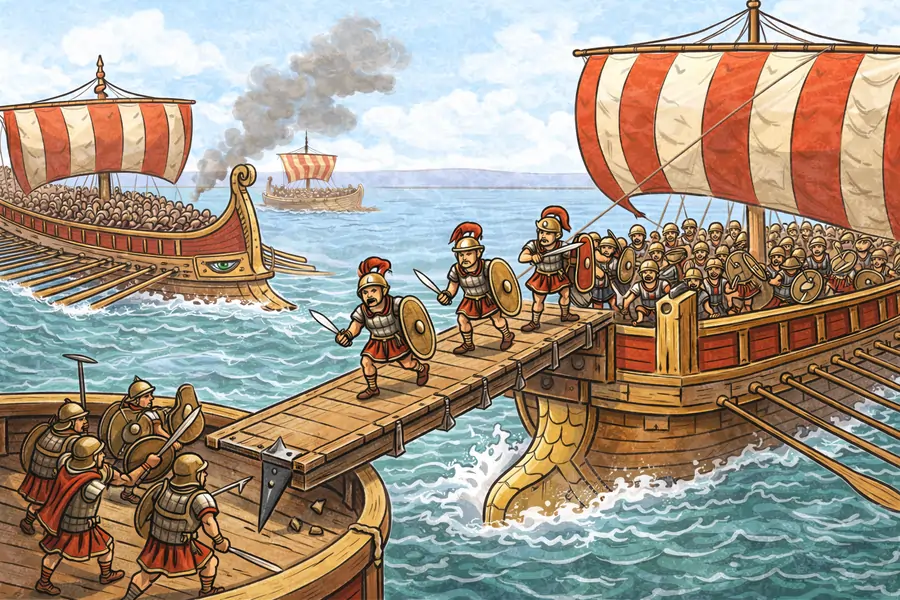
The solution came through Roman ingenuity: the Corvus, a Roman navy boarding device. The Corvus (Latin for "crow") was a rotating ship-mounted ramp or drawbridge equipped with an iron spike at its end. When deployed, the spike would pierce and lock onto enemy warships, transforming naval battles into land combat. Roman legionnaires would storm across the corvus bridge, overwhelming Carthaginian crews through superior close-quarters fighting. This innovation revolutionized Roman naval warfare and enabled Rome to win a series of decisive naval victories despite their inexperience at sea.
Battle of Cape Ecnomus: The Largest Naval Battle in Ancient History
The Battle of Cape Ecnomus (256 BC) stands as one of the most decisive moments in the First Punic War and arguably the largest naval battle in ancient history. With 680 warships and approximately 290,000 sailors and marines engaged, this titanic clash between Rome vs Carthage dwarfed any previous naval encounter. The Romans deployed 330 ships while the Carthaginian navy mustered 350 warships. Fought off the southern coast of Sicily, this battle would determine whether Rome could invade North Africa and strike at Carthage's homeland.
The Battle of Cape Ecnomus showcased the strengths and weaknesses of both fleets. Roman quinqueremes were bulkier and slower than their Carthaginian counterparts, limiting maneuverability. The Carthaginian navy initially dominated through traditional ramming tactics, sinking numerous Roman vessels. However, the Roman Corvus proved decisive. As Roman legionnaires boarded and captured Carthaginian ships one by one, the enemy center lost heart and fled. The Carthaginians lost 30 ships sunk and 64 captured, with 30,000 to 40,000 casualties (mostly prisoners). Roman losses totaled 24 ships sunk and 10,000 casualties. This Roman naval warfare victory opened the path to Africa.
Years of Stalemate: Disasters and Resilience in Punic Wars History
After the Roman victory in the Battle of Cape Ecnomus, the Romans under Regulus landed in North Africa, bringing the fight directly to Carthaginian territory. The invasion proceeded successfully, and by 255 BC, the Carthaginians sued for peace. However, Regulus offered such harsh terms that Carthage chose to continue fighting. The Carthaginians suffered another defeat at the Battle of Cape Hermaeum, losing 114 ships captured. But nature proved more destructive than any battle—a devastating storm destroyed 384 Roman ships and drowned 100,000 men. The Corvus Roman navy boarding bridges made ships top-heavy and unstable in rough weather, contributing to these catastrophic losses. Rome abandoned the corvus after this disaster.
The First Punic War dragged on with neither side gaining decisive advantage. The Carthaginians recaptured Akragas but razed it, unable to defend the city. Rome demonstrated remarkable resilience by rebuilding their navy with 220 new ships—though storms claimed 150 of them. Rome gradually conquered most of Sicily through land campaigns, but the Carthaginian navy remained formidable. In 249 BC, Carthage defeated the Roman fleet at the Battle of Drepana, followed by another victory at the Battle of Phintias. Roman naval warfare expertise was still developing, and Carthage's maritime superiority remained a constant threat.
Rome's Final Victory: The End of the First Punic War
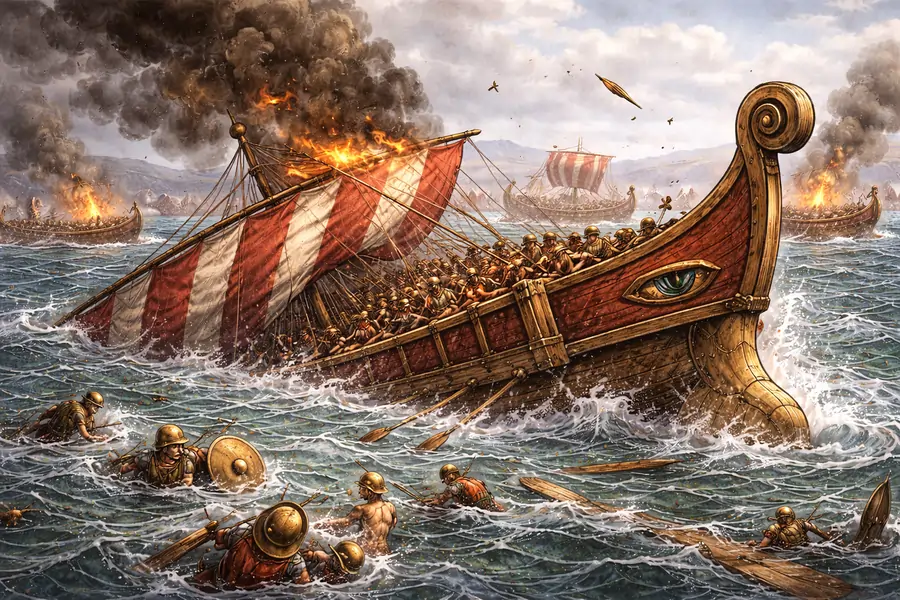
After years of grinding stalemate, Rome made one final push. In 243 BC, the Romans rebuilt their fleet once more and blockaded the remaining Carthaginian garrisons in Sicily. When the Carthaginian navy assembled a relief fleet, they met disaster at the Battle of the Aegates Islands in 241 BC. Surrounded and without hope of relief, Carthaginian forces in Sicily sued for peace. The treaty terms were devastating: Carthage paid massive reparations to Rome, and Sicily became Rome's first overseas province. The First Punic War had transformed Rome vs Carthage dynamics forever—Rome emerged as the Mediterranean's dominant military power.
The key to Rome's victory in Punic Wars history was mentality. Carthage waged war for profit and would seek peace when costs exceeded benefits. For Rome, however, defeat was simply not an option. Roman determination to win at any cost—including building over 1,000 warships during the conflict—established Roman naval warfare dominance for the next 600 years. But Rome vs Carthage was far from over. Hannibal Barca would soon bring the fight directly to Roman soil in an even more dramatic chapter of this epic struggle.
Why Rome Won the First Punic War
The Roman victory in the First Punic War was not the result of a single decisive battle. Instead, Rome gradually overcame Carthage through persistence, innovation, and strategic adaptation. Despite suffering repeated naval disasters and heavy losses, Rome maintained pressure until Carthage could no longer continue the conflict.
Adaptation to Naval Warfare
At the start of the war, Rome had little experience at sea, while Carthage possessed the most powerful navy in the Mediterranean. Rome compensated for this disadvantage by developing the corvus boarding device, which transformed naval combat into infantry engagements. This innovation allowed Roman soldiers to fight using their strengths and helped neutralize Carthaginian naval superiority.
Roman Resilience and Shipbuilding Capacity
One of Rome's greatest advantages was its willingness to rebuild after catastrophic losses. Storms destroyed entire Roman fleets multiple times during the war, yet Rome repeatedly constructed new ships and returned to the fight. This ability to absorb losses and continue fighting placed increasing pressure on Carthage, which relied more heavily on cost-effective warfare.
Control of Sicily's Interior
While Carthage dominated the sea, Rome gradually secured control over much of Sicily through land campaigns. This restricted Carthaginian supply bases and limited their ability to project power inland. Over time, Carthage was forced to defend isolated coastal strongholds rather than conduct offensive operations.
Economic and Political Endurance
Rome treated the war as a struggle for survival and committed enormous resources to victory. Carthage, by contrast, relied heavily on mercenaries and naval operations, which were expensive to maintain. As the war dragged on, the financial burden and lack of decisive success weakened Carthaginian resolve.
The Decisive Final Naval Victory
The Roman victory at the Battle of the Aegates Islands ultimately broke Carthaginian resistance. With their fleet destroyed and Sicilian garrisons cut off, Carthage was forced to negotiate peace. This final defeat demonstrated that Rome had successfully adapted to naval warfare and overcome Carthage's greatest strength.
Through persistence, innovation, and strategic endurance, Rome transformed itself from a land power into a naval power. The First Punic War marked the beginning of Roman expansion beyond Italy and set the stage for future conflicts with Carthage.
Related Articles
Frequently Asked Questions
What was the First Punic War and why did it start?
The First Punic War (264-241 BC) was the first major conflict between Rome vs Carthage for control of the Mediterranean. It began when both powers intervened in a dispute over Messina in Sicily. The Mamertines, mercenaries controlling Messina, called for help from both Rome and Carthage when besieged by Syracuse. When both powers sent forces, their competing interests sparked a 23-year war that would determine Mediterranean supremacy. The conflict centered on Sicily, a strategically vital island for controlling trade routes and projecting power across the region.
How did Rome build a navy to fight the Carthaginian navy?
Rome's development of naval power during the First Punic War was remarkable. Initially lacking naval expertise, the Romans reverse-engineered a captured Carthaginian quinquereme to learn shipbuilding techniques. However, building ships was only the first step—the Carthaginian navy had centuries of maritime experience that Rome couldn't match through traditional tactics. The Romans overcame this through innovation, creating the corvus boarding device that transformed naval battles into infantry engagements where Roman legionnaires excelled. Over the course of the war, Rome built over 1,000 warships, establishing Roman naval warfare dominance for centuries.
What was the Corvus and how did it change Roman naval warfare?
The Corvus Roman navy boarding bridge revolutionized ancient naval combat. The corvus (Latin for 'crow') was a rotating ramp mounted on Roman warships, approximately 36 feet long and 4 feet wide, with a heavy iron spike at its end. When an enemy ship came alongside, Romans would drop the corvus, and the spike would pierce and lock onto the enemy deck. Roman legionnaires would then storm across this bridge, turning sea battles into hand-to-hand combat where Rome's superior infantry training dominated. This innovation allowed Rome to win major engagements like the Battle of Cape Ecnomus despite inferior seamanship, though the top-heavy corvus made ships unstable in storms.
What happened at the Battle of Agrigentum?
The Battle of Agrigentum in 262 BC was Rome's first major land victory in the First Punic War. After forcing Syracuse to become their ally, the Romans besieged Carthage's main Sicilian base at Agrigentum. When a large Carthaginian relief force arrived, Roman legions decisively defeated them, killing 3,000 infantry and 200 cavalry while capturing 8 war elephants. However, the victory came at enormous cost—Rome lost one-third of its besieging army (30,000 infantry and 540 cavalry). Additionally, the Carthaginian garrison inside Agrigentum escaped by filling Roman trenches with straw. While Rome captured the city, the incomplete victory demonstrated that defeating Carthage would require a much longer, costlier struggle.
What was the Battle of Cape Ecnomus and why was it significant?
The Battle of Cape Ecnomus in 256 BC was the largest naval battle in ancient history and a turning point in Punic Wars history. The engagement involved approximately 680 warships and 290,000 sailors and marines—Rome fielded 330 ships while the Carthaginian navy deployed 350. Fought off southern Sicily, the battle tested Rome's new naval capabilities against Carthage's maritime expertise. Despite initial Carthaginian success using traditional ramming tactics, the Corvus Roman navy boarding bridges proved decisive. Roman legionnaires captured or sank 94 Carthaginian ships while losing only 24 of their own. This victory opened the path for a Roman invasion of North Africa and demonstrated that Rome could challenge Carthaginian naval supremacy.
How did Rome vs Carthage end in the First Punic War?
The First Punic War concluded in 241 BC after 23 years of grueling conflict. Following years of stalemate, Rome rebuilt its fleet one final time in 243 BC and blockaded remaining Carthaginian forces in Sicily. When Carthage sent a relief fleet, Rome decisively defeated them at the Battle of the Aegates Islands in 241 BC. With no hope of relief, Carthaginian forces surrendered. The peace treaty was harsh: Carthage paid massive reparations and ceded Sicily, which became Rome's first overseas province. Rome vs Carthage had transformed Rome from a regional Italian power into the Mediterranean's dominant force. However, this humiliating defeat planted the seeds for the even more devastating Second Punic War, when Hannibal would invade Italy itself in revenge.