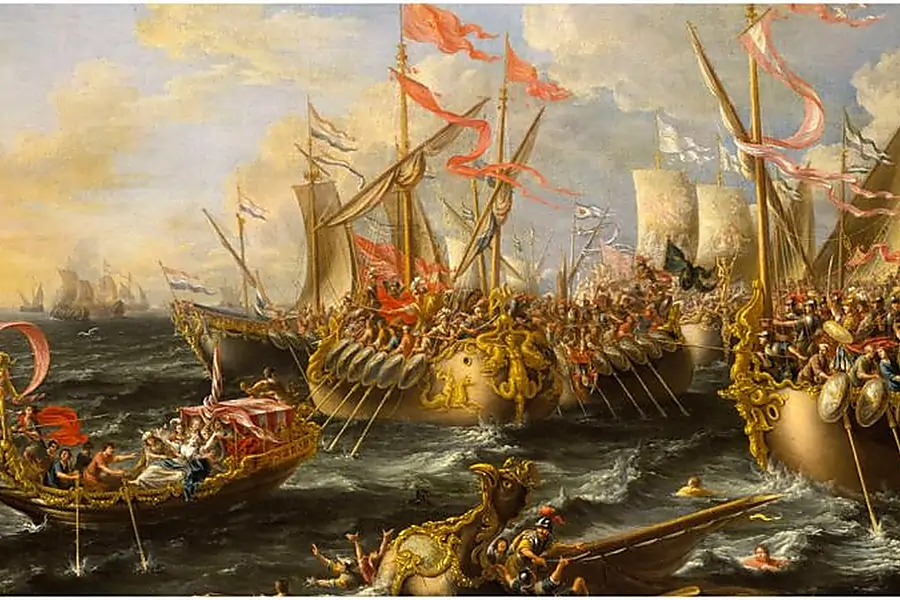
At the start of the First Punic War, Carthage ruled the Mediterranean Sea. It had one of the most experienced naval forces in the ancient world. Rome, by contrast, had no navy nor any shipbuilding experience. Yet within just two decades, Rome not only challenged Carthage at sea but defeated it decisively. This transformation reshaped Mediterranean history, allowed Rome to expand overseas, and laid the foundation for its later victories in the Punic Wars. This article explains how the corvus boarding device changed naval warfare, and how Rome ultimately overcame Carthage's maritime superiority.
Table of Contents
- Naval Power Before the First Punic War
- Strength of the Carthaginian Navy at the Start of the War
- Types of Ships Used by Carthage and Rome
- Rome Before the War: A Land Power Without a Navy
- How Rome Built a Navy From Scratch
- Roman Training and Organizational Innovation
- The Corvus: Rome's Game-Changing Weapon
- Battle of Mylae: Rome's First Naval Victory
- Battle of Cape Ecnomus: One of the Largest Naval Battles Ever
- How Rome Eventually Dominated the Sea
- Why the Carthaginian Navy Declined
- Long-Term Impact of Roman Naval Victory
- Conclusion
Naval Power Before the First Punic War
Before the First Punic War, Carthage was the dominant naval power in the western Mediterranean. The city's wealth came from maritime trade, colonial networks, and naval supremacy. Carthaginian fleets protected shipping lanes, enforced tribute, and projected power across North Africa, Spain, Sardinia, and Sicily. Carthage did not have any civilization strong enough to challenge its dominance in the western Mediterranean.
Rome, meanwhile, was primarily a land-based power focused on the Italian peninsula. Its military system is centered around the citizen army and the flexible legion structure. However, its navy was virtually nonexistent. They did not have the expertise to build warships. They also did not have skilled sailors to challenge Carthage at sea.
The conflict that forced Rome to develop a navy began with tensions in Sicily. These tensions escalated into the First Punic War, a long struggle that would reshape Mediterranean power. With no way of securing a decisive victory at Sicily, Rome was forced to expand its navy and bring the fight to the Carthaginians at home.
Strength of the Carthaginian Navy at the Start of the War
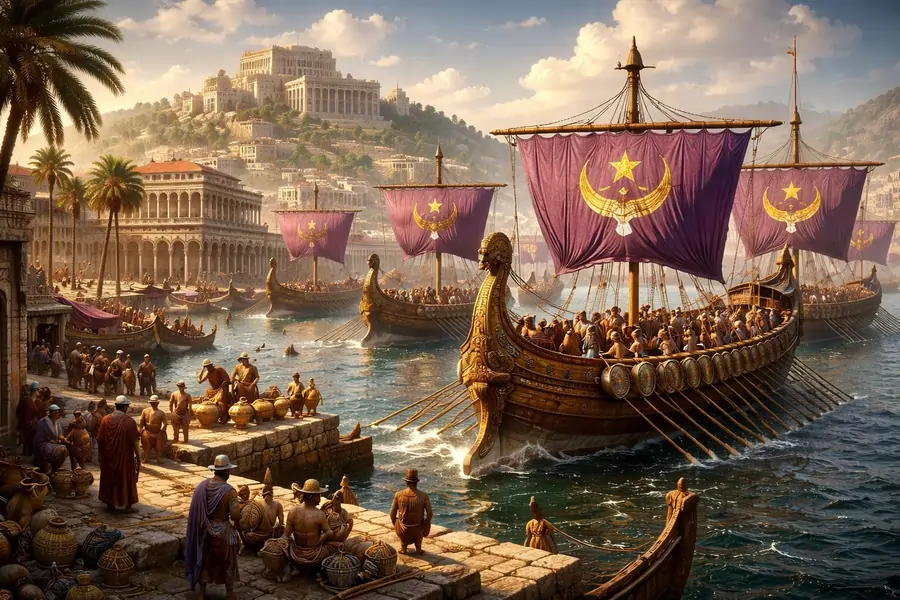
At the outbreak of the First Punic War in 264 BC, Carthage possessed one of the most formidable navies in the ancient world. Unlike Rome, Carthage had centuries of maritime experience inherited from Phoenician seafaring traditions. The Carthaginian navy had several major advantages:
- Professional sailors with lifelong maritime experience
- Highly trained naval commanders
- Established shipyards and naval infrastructure
- Advanced naval tactics focused on maneuver warfare
- Superior seamanship and navigation skills
- Large fleet numbers ready for deployment
Ancient sources suggest Carthage could deploy around 120-150 warships at the beginning of the conflict, with the capacity to rapidly expand this number. These ships were mostly Quinqueremes, the dominant warship of the era. Carthage also controlled important naval bases:
- Carthage (North Africa)
- Lilybaeum (Sicily)
- Panormus (Sicily)
- Sardinia naval stations
- Spanish coastal ports
This network allowed Carthage to dominate the Mediterranean Sea lanes. Rome had never faced such a naval opponent before. It was difficult for the Romans to build their navy, as they lacked the necessary infrastructure to construct and maintain warships.
Types of Ships Used by Carthage and Rome
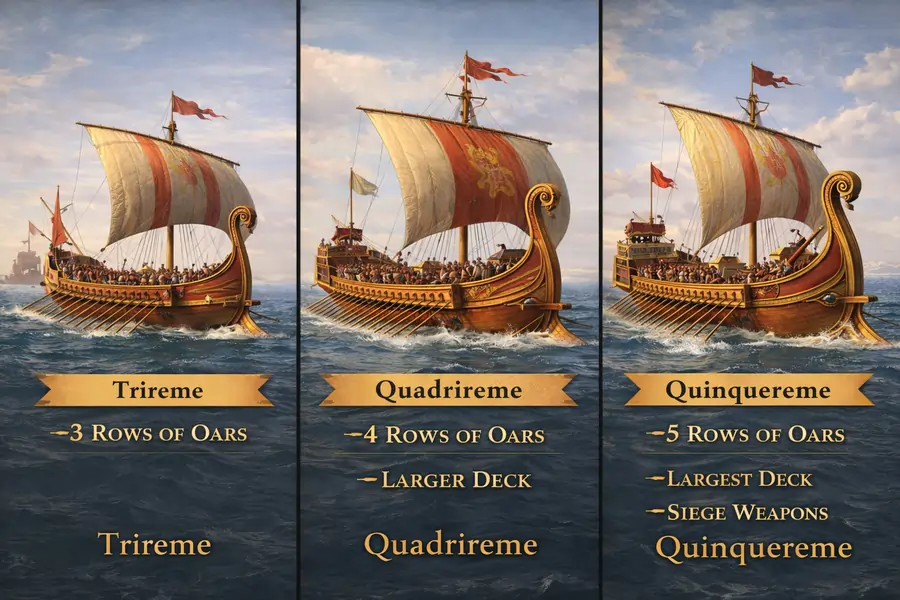
Naval warfare during the First Punic War relied heavily on specialized warships designed for speed, ramming, and maneuverability. The most important ship types included:
Trireme
Older but still used, triremes were lighter and faster vessels. They were sometimes used for scouting and communication. They had three rows of rowers (170 in total)
Quadrireme
Less common than Quinqueremes, these ships balanced speed and combat power. They were larger than Triremes but smaller than Quinqueremes.
Quinquereme
The Quinquereme was the primary warship used by both Rome and Carthage. It carried approximately 300 rowers and 120 marines. The ship's bronze ram was designed to smash into enemy hulls. Carthaginian Quinqueremes were faster and more maneuverable due to experienced crews.
Roman Modifications
Rome later modified its Quinqueremes to carry more soldiers, transforming naval battles into infantry engagements. The Corvus, which was a boarding platform, allowed Roman sailors to grapple with enemy ships. This change played a decisive role in early Roman naval victories.
Rome Before the War: A Land Power Without a Navy
At the beginning of the First Punic War, Rome had almost no navy. Unlike Carthage, Rome lacked:
- Naval tradition
- Experienced sailors
- Shipbuilding infrastructure
- Naval tactics
- Maritime culture
This made Rome's decision to challenge Carthage at sea extremely risky. However, Roman leaders understood that victory in Sicily required a strong naval presence. Without ships, Rome could not transport troops, protect supply lines, or challenge Carthaginian dominance. This strategic shift mirrors later Roman adaptations seen during the Second Punic War, where Rome repeatedly changed tactics to defeat Hannibal.
How Rome Built a Navy From Scratch
Rome's naval transformation remains one of the most remarkable military mobilizations in history. According to ancient accounts, Rome by chance captured a fully intact Carthaginian Quinquereme and used it as a blueprint. They reverse-engineered the workings of the Quinquereme and began mass-producing it.
Roman shipyards rapidly produced approximately 100 Quinqueremes and 20 triremes in a short period. This industrial effort demonstrated Rome's organizational strength. Key steps in Rome's naval construction:
- Captured Carthaginian ship used as model
- Mass shipbuilding across Italian coast
- Use of allied manpower
- Standardized ship design
- Centralized production
However, building ships was only the first challenge. Rome still lacked trained sailors to man these ships. Naval warfare required skillful seamanship and naval tactics of the era that required careful maneuvering of the vessel. Rome lacked the expertise to challenge Carthage in a conventional naval engagement.
Roman Training and Organizational Innovation
To overcome the experience gap, Rome developed innovative training methods. Rowers practiced on land using mock ship benches. Soldiers trained for boarding combat. Roman strengths included:
- Discipline from legionary system
- Large manpower reserves
- Strong command hierarchy
- Ability to replace losses quickly
Rome essentially turned naval warfare into land combat at sea. This approach would soon be reinforced by a revolutionary device.
The Corvus: Rome's Game-Changing Weapon
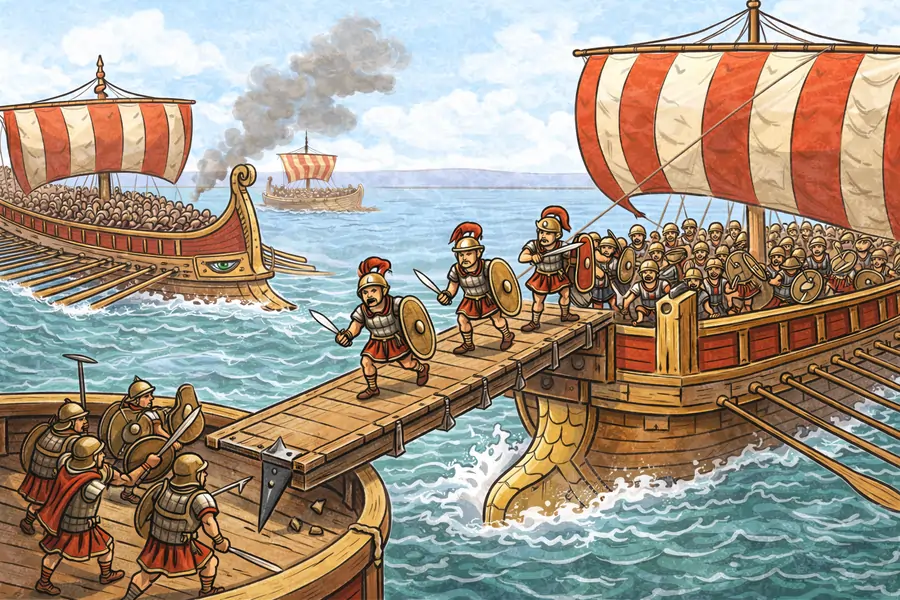
The corvus was a boarding bridge with a spike at the end. It allowed Roman ships to lock onto enemy vessels. Once attached, Roman infantry crossed and fought hand-to-hand. This innovation neutralized Carthaginian naval advantages. Instead of maneuver warfare, battles became infantry engagements. This revolutionised naval warfare in a short period of time.
Advantages of the corvus:
- Neutralized enemy maneuvering
- Favored Roman infantry skill
- Reduced importance of seamanship
- Turned naval combat into land combat
Battle of Mylae: Rome's First Naval Victory
The Battle of Mylae in 260 BC marked Rome's first major naval victory. Roman commander Gaius Duilius used the corvus to capture multiple Carthaginian ships. Carthaginian crews expected traditional ramming combat. Instead, Roman soldiers boarded their ships.
The results of the battle were devastating for Carthage. Dozens of Carthaginian ships were captured. Rome had won its first naval engagement against Carthage. It boosted Roman morale while the Carthaginians were shaken, and their naval invincibility was broken. Rome could now challenge Carthage for naval dominance on even footing.
Battle of Cape Ecnomus: One of the Largest Naval Battles Ever
The Battle of Cape Ecnomus in 256 BC was one of the largest naval battles in history. Rome deployed around 330 ships. Carthage fielded roughly 350 ships. Roman formations protected transports carrying invasion forces to Africa. Again, the corvus played a major role in the battle. It enabled the boarding of Carthaginian ships and gave Rome a decisive victory. This victory allowed the invasion of North Africa and an end to the First Punic War.
How Rome Eventually Dominated the Sea
Rome's navy was not overnight. The war lasted over two decades. Rome suffered storms, losses, and rebuilding efforts. Eventually, Rome achieved naval superiority through:
- Massive ship production
- Adaptation of tactics
- Improved seamanship
- Economic endurance
- Control of Sicily
Rome's final victory at the Battle of the Aegates Islands in 241 BC destroyed Carthage's fleet. This victory ended the First Punic War and established Rome as the dominant Mediterranean naval power. Rome had managed to build over 1000 ships over the course of the War.
Why the Carthaginian Navy Declined
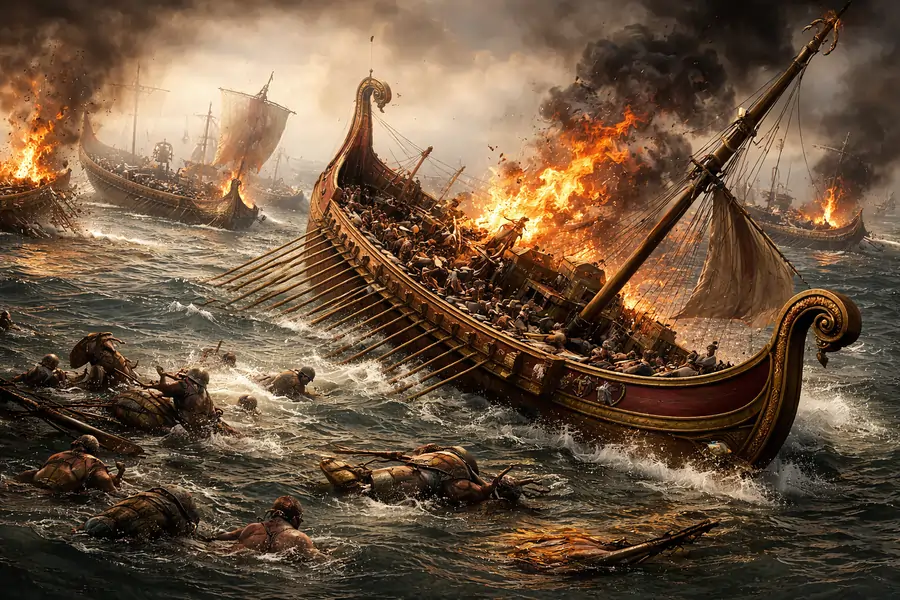
Several factors contributed to Carthage's naval decline:
- Loss of experienced crews
- Financial strain
- Roman adaptation
- Overreliance on mercenaries
- Strategic mistakes
These weaknesses meant that Rome was the dominant naval power after the First Punic War. This later affected Carthage during conflicts involving Hannibal Barca and the later Punic Wars. Hannibal was not able to use the Carthaginian navy for fear of a naval battle, which led to the legendary crossing of the Alps.
Long-Term Impact of Roman Naval Victory
Rome's naval victory transformed Mediterranean geopolitics. Rome gained control over Sicily, Sardinia, and Corsica. Rome gained naval superiority in the Mediterranean. This set the stage for later conflicts, including:
Rome's resilience after defeats is what brought it final victory. In the First Punic War, storms and battles had claimed hundreds of Roman ships. However, they were able to rebuild their fleet several times to claim victory. The Fabian strategy later reflected similar strategic patience. The final destruction of Carthage in the Third Punic War marked the ultimate consequence of Rome's rise as a naval and military superpower.
Conclusion
Rome's defeat of the Carthaginian navy remains one of history's most remarkable military transformations. Carthage began the First Punic War as the dominant maritime power. Rome had almost no naval experience. Through innovation, organization, and determination, Rome built a fleet, introduced the corvus, adapted tactics, and gradually gained superiority. By the end of the war, Rome controlled the Mediterranean.
This transformation not only decided the First Punic War but also shaped the future of the Roman Empire. Rome's ability to adapt, innovate, and persist allowed it to defeat a superior naval power and change history. The Punic Wars remain among the most fascinating conflicts in ancient warfare, as explored in Why the Punic Wars are so interesting.
Related Articles
Frequently Asked Questions
Why did Rome build a navy during the First Punic War?
Rome built a navy during the First Punic War because it could not defeat Carthage without challenging its control of the sea. Carthaginian fleets dominated Sicily and Mediterranean supply routes. To transport troops, protect logistics, and break Carthage's naval blockade, Rome was forced to construct a fleet from scratch.
What type of ships did Rome copy from the Carthaginians?
Rome copied the quinquereme, the dominant warship used by Carthage during the First Punic War. According to ancient sources, the Romans captured a Carthaginian quinquereme and used it as a model. They then mass-produced similar ships, allowing Rome to rapidly build a competitive navy.
How did the Roman corvus change naval warfare?
The Roman corvus was a boarding bridge with a spike that locked onto enemy ships. Instead of maneuvering and ramming, Roman soldiers crossed the bridge and fought hand-to-hand. This transformed naval battles into infantry combat, reducing Carthage's advantage in seamanship and maneuver tactics.
Why was the Carthaginian navy stronger at the start of the war?
The Carthaginian navy was stronger because Carthage had centuries of maritime experience, professional sailors, and established shipyards. Their crews were highly trained in maneuver warfare and naval tactics, while Rome initially had almost no naval tradition, ships, or experienced sailors.
What was Rome's first major naval victory against Carthage?
Rome's first major naval victory was the Battle of Mylae in 260 BC. Roman commander Gaius Duilius used the corvus boarding device to capture several Carthaginian ships. This battle proved that Rome could defeat Carthage at sea and marked a turning point in the First Punic War.
How did Rome eventually gain naval dominance over Carthage?
Rome gained naval dominance through large-scale shipbuilding, improved training, and tactical adaptation. After early victories using the corvus, Rome continued rebuilding fleets, improving seamanship, and wearing down Carthage economically. The final Roman victory at the Battle of the Aegates Islands in 241 BC secured control of the sea.