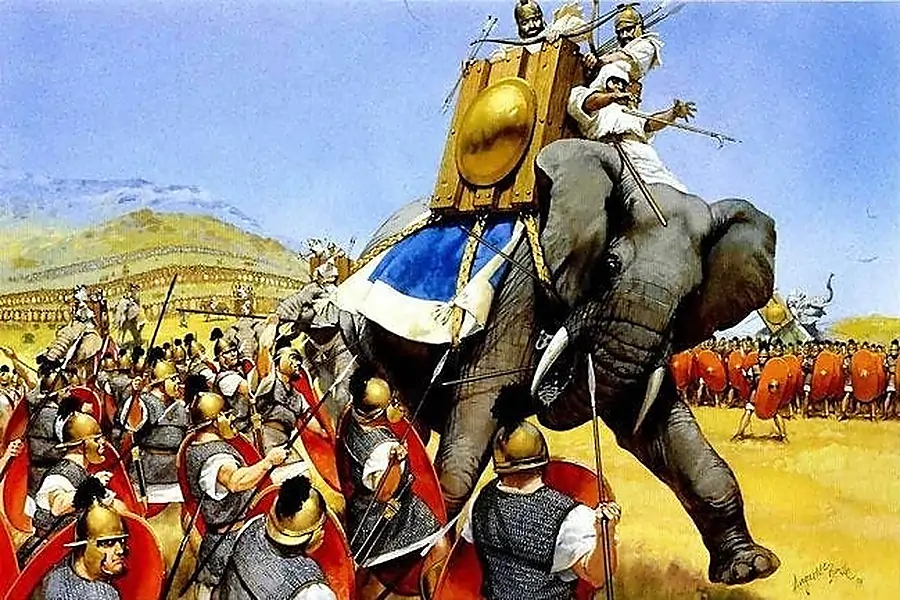
Few sights in ancient warfare were as terrifying as the advance of war elephants. Towering above infantry, armored in leather or bronze, and driven forward with drums and shouting handlers, elephants were the tanks of the ancient world. From India to North Africa, commanders deployed them to break enemy formations, cause psychological shock, and reshape battlefield tactics. Among all civilizations that used them, Carthage became one of the most famous — especially during the Punic Wars against Rome, where Hannibal Barca marched 37 war elephants across the Alps. Let us analyse the use of war elephants in ancient warfare, which forced enemy armies to adapt in order to overcome their overwhelming presence on the battlefield.
Table of Contents
- The Origins of War Elephants in Ancient Warfare
- Civilizations That Used War Elephants
- Types of Elephants Used in Ancient Warfare
- How War Elephants Were Trained
- How War Elephants Were Used in Battle
- Strengths of War Elephants
- Weaknesses of War Elephants
- Carthage and the Adoption of War Elephants
- Hannibal and the Famous Alpine Crossing
- Roman Adaptation to War Elephants
- Case Study: War Elephants at the Battle of Zama (202 BC)
- Case Study: Effective Use of Elephants at the Battle of Hydaspes
- The Decline of War Elephants
- The Legacy of War Elephants
- Related Articles
The Origins of War Elephants in Ancient Warfare
The use of elephants in warfare began in South Asia, where rulers discovered that trained elephants could function as mobile platforms, shock troops, and psychological weapons. Indian armies developed sophisticated systems for training, equipping, and deploying elephants centuries before Mediterranean powers adopted them. Training was very critical, as an untrained elephant could be more of a vulnerability than an asset.
Elephants were valued because of the advantages they brought to the battlefield:
- Immense size and intimidation: For armies that had not encountered elephants before, it was a demoralizing and terrifying sight.
- Ability to break infantry formations: They were the shock force of ancient armies. The tanks that broke enemy formations.
- Elevated platform for archers and javelin throwers: Elephants were often manned with a "howdah," which is a carriage or platform for archers to fire their arrows/javelins at enemy troops.
- Resistance to cavalry charges: Horses are afraid of elephants and would not charge at them directly.
- Psychological impact on inexperienced troops: Inexperienced troops would often break formation and flee at the sight of a charging elephant.
The use of war elephants had been refined through trial and error. By the time Persian and Hellenistic armies began using elephants, their role had already been refined. They were no longer just large animals — they were integrated battlefield units with handlers, escorts, and specific tactical roles.
Civilizations That Used War Elephants
War elephants were used by multiple civilizations over a span of a thousand years. Their adoption spread from India westward into Persia, then into the Hellenistic kingdoms, and finally into North Africa and the Mediterranean. Major users of war elephants included:
- Ancient Indian kingdoms and the Mauryan Empire — Indian armies deployed elephants in massive numbers, sometimes fielding hundreds in a single battle. They formed the backbone of many armies and were used as crack troops, mobile command platforms, and symbols of royal power.
- Achaemenid Persian Empire — Persian forces adopted elephants from eastern territories and used them primarily to disrupt enemy formations. Their appearance in Persian armies introduced Mediterranean forces to elephants as battlefield weapons.
- Hellenistic kingdoms such as the Seleucids and Ptolemies — Successor states of Alexander the Great used elephants as elite battlefield units. Large elephant corps became a hallmark of Hellenistic warfare, often deployed in front of infantry lines to break enemy phalanxes.
- Carthaginian Empire — Carthage used North African elephants to disrupt enemy formations. Their use during the Punic Wars, especially under Hannibal, made them famous in Mediterranean warfare and forced Rome to develop anti-elephant tactics.
- Kingdoms in Southeast Asia — Armies in regions such as Thailand, Burma, and Cambodia used elephants for centuries. They were often employed as command platforms and were central to warfare in jungle terrain.
- Limited use by Rome after encountering them — Rome occasionally used captured elephants, mostly for prestige or specialized situations. However, Romans became more famous for developing effective countermeasures rather than widespread adoption.
Types of Elephants Used in Ancient Warfare
Not all war elephants were the same. Different regions used different species depending on availability and size. The most common types were:
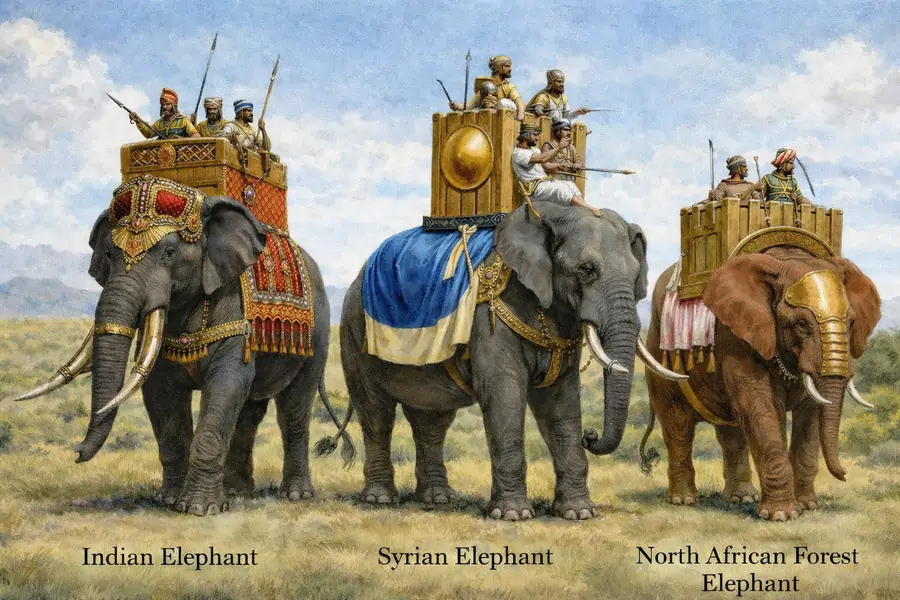
- Indian elephants — Large, strong, and highly trainable, Indian elephants were considered the most effective war elephants in antiquity. They could carry wooden towers (howdahs) holding multiple soldiers armed with bows, javelins, or spears. Indian armies often deployed them in large numbers to break enemy lines, trample infantry, and disrupt cavalry. Their size made them more difficult to stop, and they were widely used by Indian kingdoms and later by Hellenistic rulers who obtained them through eastern campaigns and trade.
- Syrian elephants — These elephants were used primarily by the Seleucid Empire and were likely a now-extinct population related to Indian elephants but slightly smaller. Seleucid rulers maintained a dedicated elephant corps and used them as elite shock units in large battles. Syrian elephants were often deployed in front of phalanx formations to disrupt enemy infantry before the main engagement. Their use became a defining feature of Hellenistic warfare, particularly in conflicts between successor kingdoms after Alexander the Great.
- North African forest elephants — Used by Carthage, these elephants were smaller than Indian elephants but still formidable. They were easier to transport and required less logistical support, making them suitable for rapid deployments. Carthaginian elephants typically carried a mahout and occasionally one or two soldiers rather than large towers. Their primary role was psychological shock and disruption of enemy formations. These elephants became famous during the Punic Wars, especially in Hannibal's campaigns against Rome, including his march across the Alps.
How War Elephants Were Trained
Training was very crucial for the effectiveness of war elephants. Training war elephants required years of preparation. The process involved taming, conditioning, and battlefield exposure. Handlers taught elephants to move toward noise, ignore fear, and follow commands even during chaotic combat.
Training included:
- Exposure to shouting and drums: Loud drums and instruments were often used to spook elephants. So it was essential that they were used to loud noises to prevent them from going berserk.
- Learning directional commands: Mahouts needed to control the movement of the elephants to charge toward an objective.
- Charging formations: Elephants usually do not charge directly at an enemy formation made up of shields and spears. However, a highly trained war elephant could be made to overcome this and charge right at the enemy formation.
- Stepping over obstacles: Through careful training and instructions given by the trainer, the elephants are made to step over obstacles like logs, ditches, and fallen soldiers on the battlefield.
- Operating alongside infantry: This was crucial as the elephants should not trample over allied troops. They need to fight alongside their own infantry.
Handlers, known as mahouts, played a crucial role. They controlled elephants using voice commands, pressure, and sometimes tools. In extreme situations, handlers carried a spike to kill the elephant if it panicked and threatened friendly troops.
How War Elephants Were Used in Battle
War elephants were typically deployed in front of the army. Their primary role was to disrupt enemy formations before infantry engagement. Once enemy lines broke, infantry and cavalry exploited the chaos. This is very similar to how tanks are used in modern warfare to exploit enemy weaknesses. Common tactical uses included:
- Shock charges against infantry — Elephants were driven directly into enemy foot soldiers to break tight formations, causing disorder that infantry could exploit.
- Breaking cavalry formations — Horses unfamiliar with elephants often panicked, allowing elephants to disrupt or scatter enemy cavalry units.
- Protecting flanks — Commanders placed elephants on the wings of an army to deter cavalry attacks and secure vulnerable sides.
- Guarding vulnerable troops — Elephants were used to shield missile troops, reserves, or command units from sudden assaults.
- Creating psychological panic — The noise, size, and movement of elephants frightened inexperienced soldiers, sometimes causing formations to collapse before contact.
Commanders also used elephants defensively. Positioned in front of lines, they deterred cavalry charges and slowed enemy advances.
Strengths of War Elephants
War elephants offered several advantages that made them attractive to commanders.
- Psychological terror against inexperienced troops
- Ability to disrupt tight formations like the phalanx
- Resistance to horses unfamiliar with elephants
- Breaking up unit cohesion during the start of the battle
These strengths made elephants particularly effective against armies that had never encountered them. Early Roman forces initially struggled when facing elephants in the Punic Wars.
Weaknesses of War Elephants
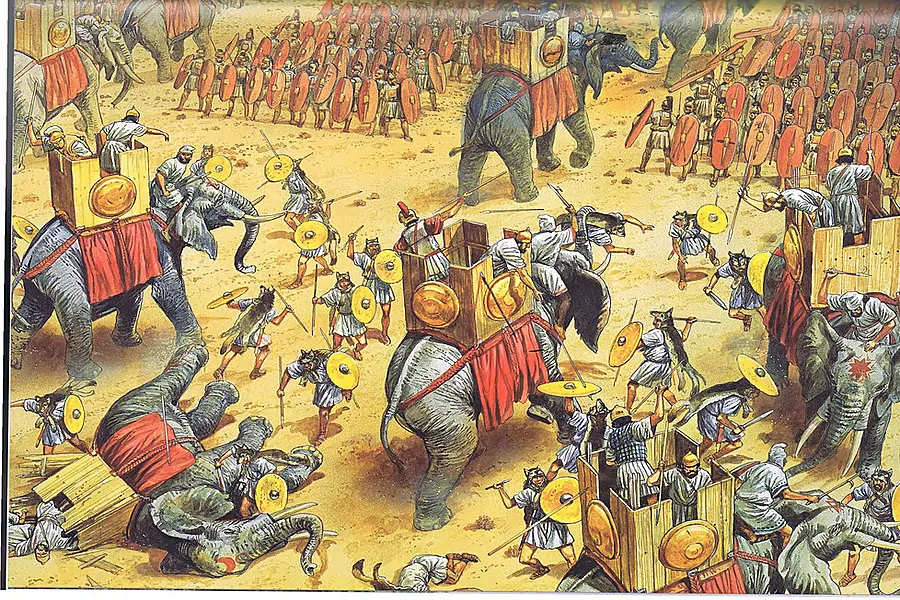
Despite their advantages, elephants had serious limitations. These weaknesses often determined their effectiveness.
- Difficult to control once panicked
- Vulnerable to missile fire
- Could trample friendly troops
- Required extensive logistics and training
- Limited maneuverability
Armies learned to exploit these weaknesses. Once disciplined troops developed anti-elephant tactics, elephants became less decisive.
Carthage and the Adoption of War Elephants
Carthage adopted elephants as part of its combined arms doctrine. The Carthaginian military relied heavily on mercenaries, cavalry, and specialized units. Elephants fit naturally into this structure. During the conflicts leading to the First Punic War, Carthage began integrating elephants more consistently. Their presence became even more prominent in the Second Punic War, when Hannibal Barca led his army into Italy.
Hannibal's reputation as one of history's greatest commanders is discussed in top military generals in history. His use of elephants contributed to his psychological warfare strategy.
Hannibal and the Famous Alpine Crossing
One of the most dramatic moments in military history was Hannibal's crossing of the Alps. He brought elephants across harsh mountain terrain, an extraordinary logistical feat. Although many elephants were lost during the crossing, their survival demonstrated Carthaginian determination. The presence of elephants also amplified Hannibal's legend and intimidated Roman forces.
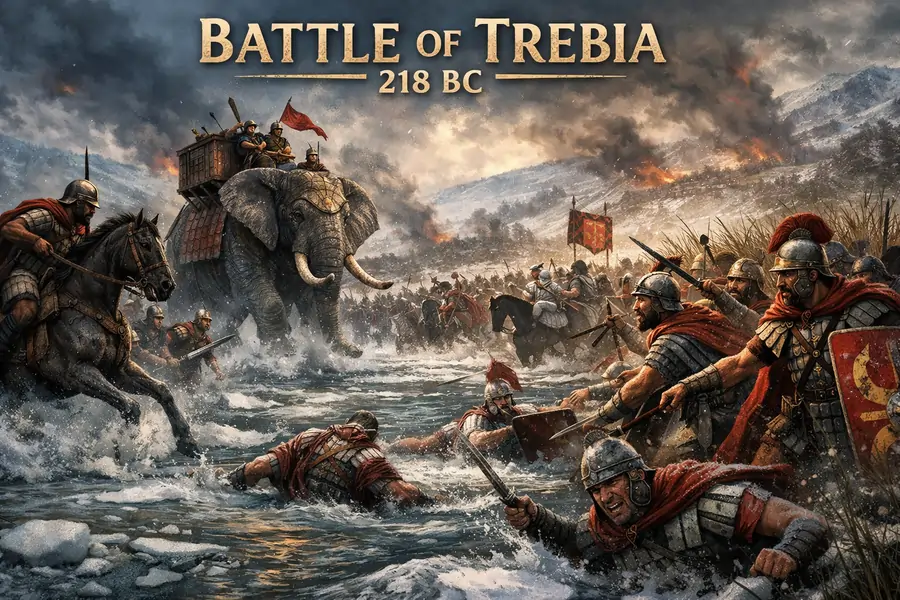
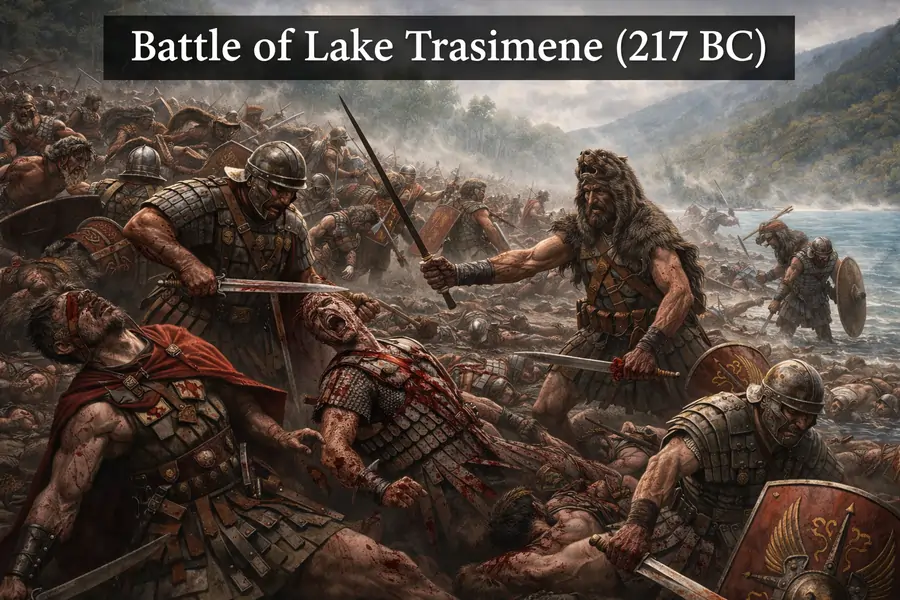
This campaign eventually led to early Roman defeats including Battle of Trebia and Battle of Lake Trasimene. Hannibal's campaign is detailed further in Hannibal Barca biography.
Roman Adaptation to War Elephants
Rome initially struggled against elephants. However, Roman discipline allowed them to adapt quickly. Over time, they developed countermeasures including:
- Opening lanes in formations
- Targeting handlers
- Using javelins and missiles
- Making loud noises to panic elephants
- Using flexible manipular formations
These adaptations would prove decisive in the final confrontation between Rome and Carthage.
Case Study: War Elephants at the Battle of Zama (202 BC)
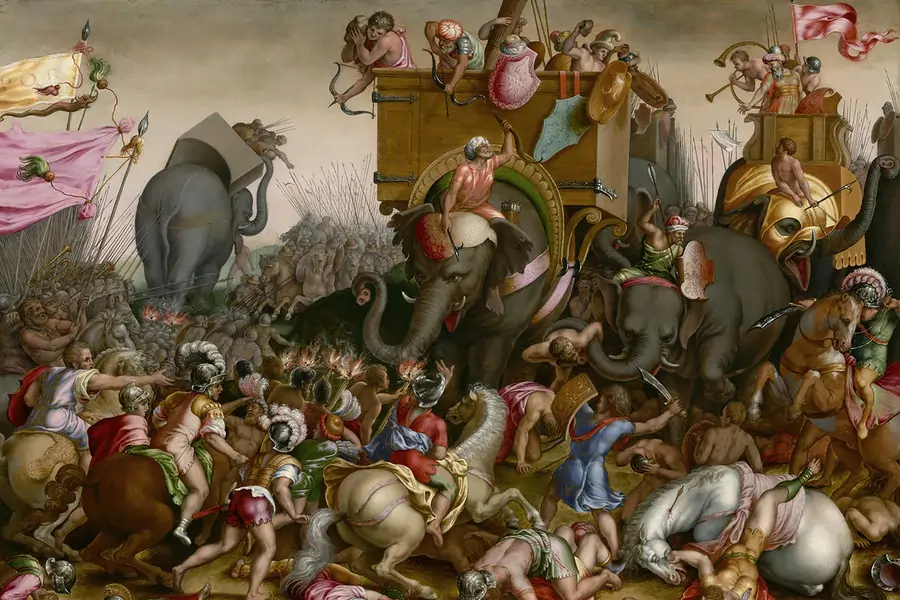
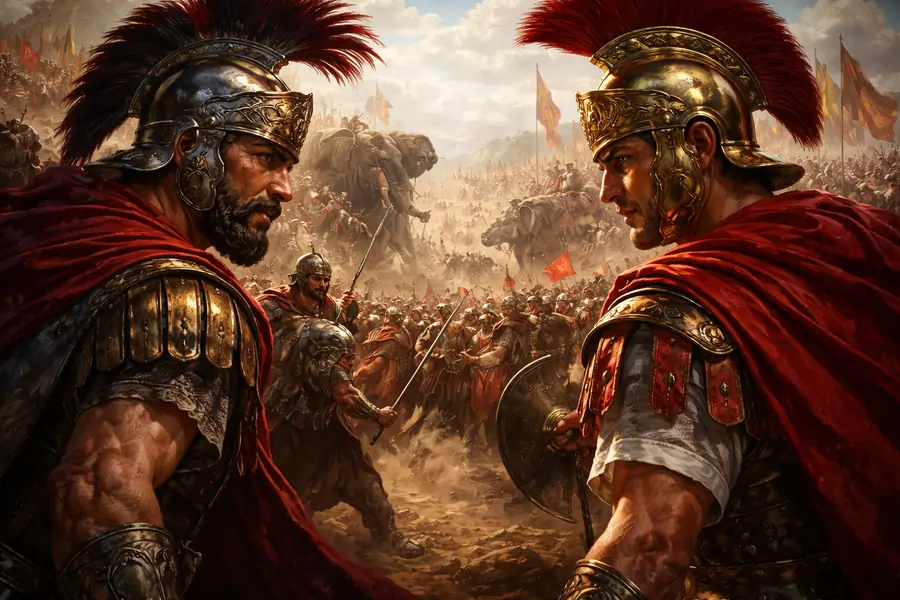
The Battle of Zama was the final battle of the Second Punic War. It pitted Hannibal against Scipio Africanus and determined the fate of Carthage. The battle is discussed in detail in Battle of Zama.
Hannibal deployed approximately 80 war elephants in front of his army. This represented one of the largest elephant deployments by Carthage. Hannibal planned to use the elephants to disrupt the Roman infantry at the start of the battle. Scipio anticipated this tactic. He arranged Roman maniples in columns rather than continuous lines. This created corridors for elephants to pass through.
When the elephants charged:
- Romans sounded trumpets
- Some elephants panicked
- Others passed harmlessly through gaps
- Roman troops attacked from sides
The elephant charge failed. Instead of breaking Roman lines, many elephants disrupted the Carthaginian cavalry. This contributed to Rome's eventual victory. Zama demonstrated both the potential and limitations of war elephants. When properly countered, they lost their shock value.
Case Study: Effective Use of Elephants at the Battle of Hydaspes
While the Battle of Zama demonstrated the limitations of war elephants against disciplined Roman formations, other engagements showed how devastating they could be when used effectively. One of the most famous examples is the Battle of Hydaspes in 326 BC, fought between Alexander the Great and King Porus on the banks of the Hydaspes River in India. This battle represents one of the largest and most tactically sophisticated uses of war elephants in ancient warfare.
King Porus deployed approximately 200 war elephants across the front of his army. Rather than concentrating them in one area, he spaced them evenly between infantry units. This created a living wall of elephants designed to disrupt any Macedonian advance. Each elephant functioned as both a shock weapon and a mobile strongpoint, with infantry positioned between them to prevent enemy penetration.
This deployment created several tactical advantages. First, the elephants prevented Alexander from using his famous cavalry charges effectively. Macedonian horses were unfamiliar with elephants and hesitated to approach them. This neutralized one of Alexander's greatest strengths — aggressive cavalry maneuver warfare. The elephants essentially anchored Porus's line and forced the Macedonians into a slower infantry engagement.
Second, the elephants disrupted Macedonian infantry formations. When the Macedonian phalanx advanced, elephants charged into the long spear formations. The massive animals pushed through sarissas, trampled soldiers, and created gaps in the phalanx. Once the tight formation broke, the Macedonian infantry became vulnerable to the Indian troops fighting between the elephants.
Third, the elephants caused sustained battlefield chaos. Even when wounded, many elephants continued fighting. Some rampaged through Macedonian ranks, while others turned unpredictably, creating confusion across the battlefield. Unlike cavalry charges, which were brief, elephants created prolonged disruption that lasted throughout the engagement.
The psychological effect was also significant. Macedonian soldiers had little prior experience fighting elephants. The noise, size, and aggressive movement of the animals caused hesitation and forced Alexander's troops to adapt in real time. Soldiers began targeting the elephants' eyes and mahouts, but this required discipline and coordination under intense pressure.
Alexander ultimately won the battle through superior maneuvering and endurance. His cavalry attacked Porus's flanks while the infantry gradually wore down the elephants. Over time, wounded elephants became harder to control and began retreating. However, the cost of victory was high, and the battle demonstrated how effective elephants could be when integrated properly into an army's battle line.
The Battle of Hydaspes showed that war elephants were most effective when used as part of a coordinated defensive front. Instead of relying on a single charge, Porus used them to anchor his formation, disrupt enemy tactics, and create sustained pressure. Even against one of history's greatest commanders, elephants forced major tactical adjustments and inflicted heavy casualties.
This battle remains one of the clearest examples of war elephants functioning as battlefield force multipliers. When deployed in large numbers, supported by infantry, and used to control terrain, elephants could reshape combat and neutralize even elite armies.
The Decline of War Elephants
Over time, war elephants became less effective. Armies developed counter-tactics. Missile weapons improved. Discipline increased. By the late Roman Republic, elephants were rare. They were occasionally used for prestige rather than decisive battlefield roles. The destruction of Carthage during the Third Punic War also ended large-scale elephant use in the western Mediterranean.
Why War Elephants Were Both Powerful and Risky
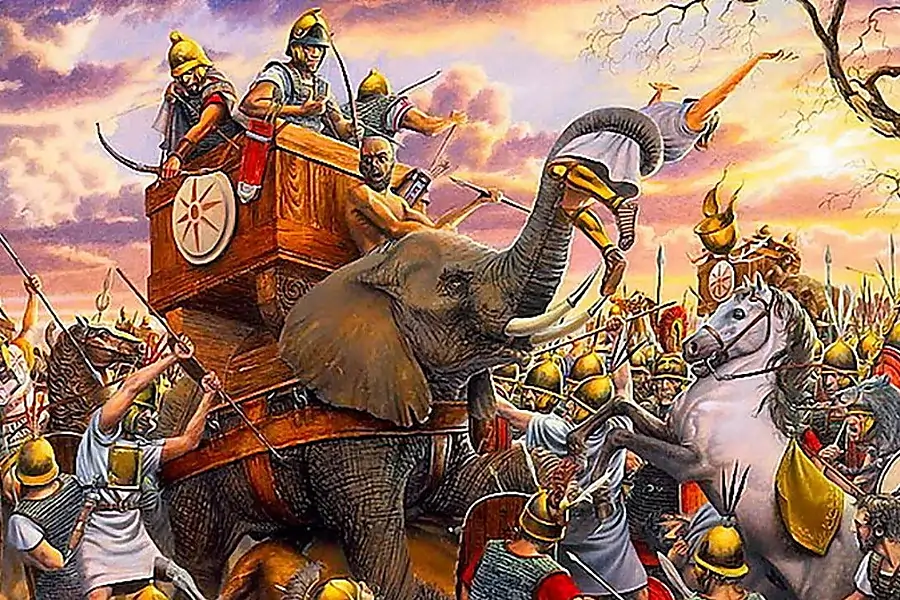
War elephants were among the most dramatic weapons of ancient warfare, but they were also unpredictable and difficult to manage. Their effectiveness depended heavily on terrain, training, and the discipline of both the elephants and the supporting troops. When used correctly, they could break enemy formations and cause panic. When mishandled, they could disrupt their own army.
Psychological Shock vs Battlefield Control
The greatest strength of war elephants was their psychological impact. Their size, noise, and sudden charge could frighten inexperienced troops and cause formations to collapse before close combat began. However, this same chaos made elephants difficult to control. Once an elephant panicked, it could turn around and trample friendly soldiers, creating confusion within its own ranks.
Shock Power vs Limited Maneuverability
Elephants were effective during the initial phase of battle, especially when charging dense infantry formations. Their mass allowed them to push through shield walls and disrupt tight formations. However, they lacked maneuverability. Once engaged, they were slow to reposition and could become isolated. This made them vulnerable to coordinated counterattacks.
Strength Against Cavalry vs Vulnerability to Missiles
War elephants were particularly effective against cavalry. Horses unfamiliar with elephants often refused to charge, allowing commanders to secure their flanks. At the same time, elephants were vulnerable to missile fire. Archers and javelin throwers could target the eyes, trunk, or mahout, causing elephants to panic and lose control.
Force Multiplier vs Logistical Burden
Elephants could act as force multipliers when supported by infantry. They created gaps in enemy formations that infantry could exploit. However, maintaining elephant units required extensive resources. They needed large quantities of food, water, and specialized handlers. Transporting elephants across difficult terrain also posed major logistical challenges.
Decisive Weapon vs Situational Effectiveness
War elephants were most effective against armies unfamiliar with them or lacking discipline. As more armies developed countermeasures—such as opening lanes, targeting handlers, and using missile weapons—their impact declined. Battles like Zama demonstrated how disciplined troops could neutralize elephants and even turn them into liabilities.
These factors made war elephants both powerful and risky. Their success depended on careful coordination, proper terrain, and disciplined support troops. When these conditions were met, elephants could reshape a battlefield. When they were not, elephants could become unpredictable and dangerous to their own side.
The Legacy of War Elephants
War elephants remain one of the most iconic features of ancient warfare. Their use by Carthage, especially under Hannibal, captured the imagination of historians and readers alike. They were the shock troops of ancient armies. When used correctly, they could turn the tide of battle and rout enemy armies.
Although eventually replaced by more reliable tactics, war elephants shaped military evolution. They forced armies to adapt, innovate, and rethink battlefield formations. Even today, they remain among the most dramatic weapons ever deployed in war.
Related Articles
Frequently Asked Questions
What species of elephants did Carthage use in the Punic Wars?
Carthage primarily used North African forest elephants during the Punic Wars. These elephants were smaller than Indian elephants but still effective as shock troops. They were easier to transport and required less logistical support, making them suitable for rapid deployments such as Hannibal's campaigns in Italy.
Why were war elephants effective against cavalry in ancient warfare?
War elephants were effective against cavalry because horses unfamiliar with elephants often panicked at their size, smell, and noise. This made cavalry charges difficult and sometimes caused mounted troops to retreat or lose formation. Commanders often placed elephants on the flanks to prevent enemy cavalry attacks.
How did Roman armies counter war elephants?
Roman armies developed several countermeasures against war elephants. These included opening gaps in their formations, using javelins and missiles to target elephants and their handlers, making loud noises to frighten them, and attacking elephants from the sides. These tactics reduced the shock value of elephant charges.
Were war elephants more effective in certain types of terrain?
War elephants were most effective on open terrain where they could charge and maintain formation. Rough ground, forests, marshes, and steep slopes limited their movement and reduced their impact. Difficult terrain also made elephants harder to control and increased the risk of them panicking.
Did Hannibal use war elephants in all his major battles in Italy?
Hannibal used elephants early in his Italian campaign, particularly at the Battle of Trebia. However, most of his elephants died due to harsh conditions, disease, and climate after crossing the Alps. As a result, elephants played little to no role in later battles such as Lake Trasimene and Cannae.
Why did war elephants decline in use after the Punic Wars?
War elephants declined because armies developed effective counter-tactics and improved discipline. Missile weapons, flexible formations, and targeting handlers made elephants less reliable. They also required extensive logistics and training. Over time, commanders preferred more predictable and easier-to-control battlefield units.