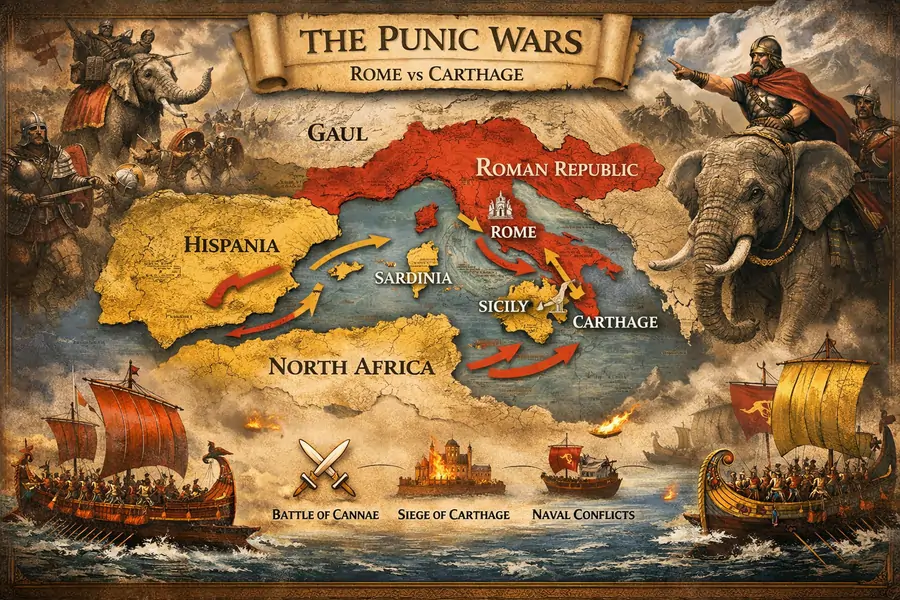
The Punic Wars are not just ancient conflicts—they are a gripping saga of ambition, revenge, genius strategy, and relentless resilience. From Hannibal's legendary march across the Alps to Rome's refusal to surrender after devastating defeats, this century-long struggle between Rome and Carthage reads like an epic drama. Filled with tactical brilliance, shocking betrayals, and world-changing consequences, the Punic Wars reveal how close history came to taking a completely different path.
The Punic Wars are full of drama and excitement. It is a thrilling tale of ambition, expansion, conflict, innovation, revenge, and ultimate victory. I have always been fascinated by the various battles fought during the Punic Wars. The large-scale naval conflict of the First Punic War made Rome the dominant naval power. The personal rivalry of Hannibal and his oath to defeat Rome in the Second Punic War. The seeds of anger that finally led to the destruction of Carthage in the Third Punic War. It was a conflict fought from 264 BC to 146 BC, marked by innovation and tactical brilliance at every step.
Table of Contents
What were the Punic Wars?
The Punic Wars were a series of three separate wars fought between Rome and the Phoenician (Punic) city of Carthage. Carthage was a maritime city focusing on trade and had control over the Mediterranean. Rome was rapidly expanding and soon came into conflict with their powerful Phoenician neighbor. The power struggle between the two giants would determine who would rule over the whole Mediterranean Sea and its lucrative trade routes.
Both cities had different mindsets and approaches to war, which would eventually result in the final result. Carthage was predominantly a merchant city with more emphasis on profit. They would recruit mercenaries to fight their wars and would not be involved in any conflict unless they could make a profit from it. Rome, on the other hand, took pride in fighting and winning. Surrender was never an option, no matter the cost. The two powerhouses would battle three times:
- The First Punic War: Rome builds its navy from scratch and emerges as a naval superpower.
- The Second Punic War: Hannibal brings Rome to its knees in crushing defeats but fails to win the war.
- The Third Punic War: "Carthago delenda est" - The final rally call to destroy Carthage once and for all.
The First Punic War: The beginning of the conflict
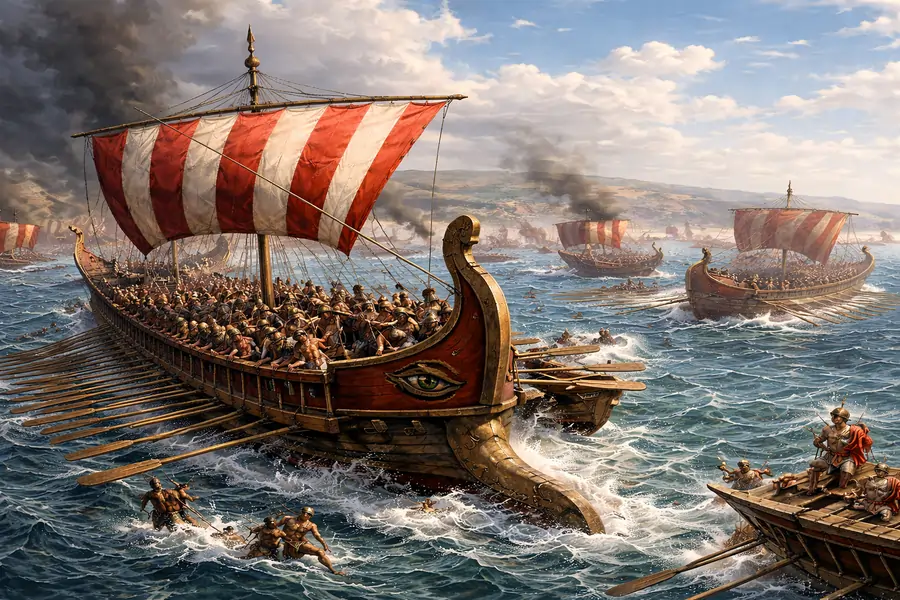
Rome was looking to expand its influence in the Mediterranean. The opportunity came when the people of Messina, a city in Sicily, called out to the Romans for help. This brought the Romans into direct conflict with Carthage. What followed was a war spanning from 264 BC to 241 BC. Rome did not have a navy, whereas the Carthaginians were a dominant naval power. This gave the Carthaginians an early advantage in the First Punic War.
Roman army vs the Carthaginian navy
Rome could not hope to challenge the Carthaginians at sea. However, the Romans were the dominant power on land. Their legions were unbeaten on land and dominated the battlefield in Sicily. A stalemate was reached, however, due to Rome dominating on land and Carthage dominating at sea. This was soon to change as Rome started to build its own navy to challenge the Carthaginians. However, the Romans did not have the experience or skilled sailors to make use of their new navy.
Roman Innovation at Sea: The Corvus
Rome knew that it could not beat Carthage in a conventional battle at sea. The Carthaginians were skilled sailors and experienced in naval warfare. Rome could not hope to beat them overnight. To overcome this difference in skill, the Romans created an innovative solution - the Corvus. The Corvus was a boarding platform attached to the Roman ships that enabled the Romans to board the enemy ships.
When the Carthaginian ships came close, the Romans would use the Corvus to attach the ships. The Roman legionnaires would then board the Carthaginian ships and change the naval battle into a land battle at sea. The Romans were good at hand-to-hand combat and would overpower and capture the enemy ships. This turned the tide of battle, with Rome winning a string of victories.
Roman Victory in the First Punic War
Despite winning naval battles, the terrain in Sicily favoured the defenders, and the Romans had slow progress. The Romans also lost hundreds of ships in storms. The Corvus was unstable in bad weather, which forced the Romans to discontinue its usage. However, the Romans had enough naval experience to win conventional battles. They rebuilt the navy again and won the Battle of the Aegates Islands in 241 BC. The Carthaginians were forced to sue for peace.
The Second Punic War: The Hannibalic War
The terms of the First Punic War were very harsh on Carthage. It lost Sicily and had to pay heavy war indemnities. Hamilcar Barca, a distinguished Carthaginian general of the First Punic War, wanted to take revenge on Rome by rebuilding his army in Spain. He had also made his son, Hannibal Barca, swear an oath of eternal enmity to Rome. When control of his father's army came to Hannibal, he was welcomed by the soldiers as their leader. He would then embark on a legendary adventure to seek revenge on Rome. The conflict with Rome started at the siege of Saguntum, where he captured the city, which was under Roman protection, triggering the Second Punic War.
The Crossing of the Alps
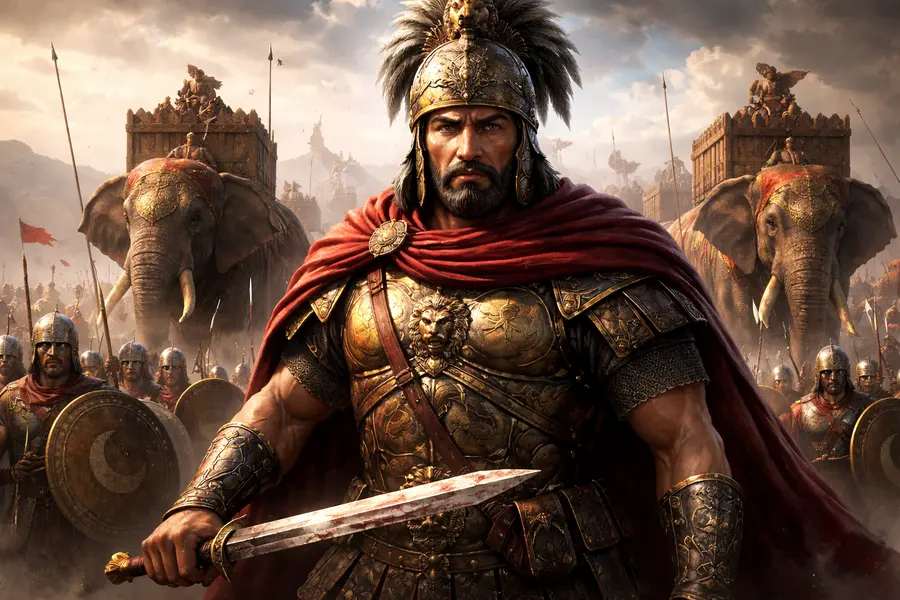
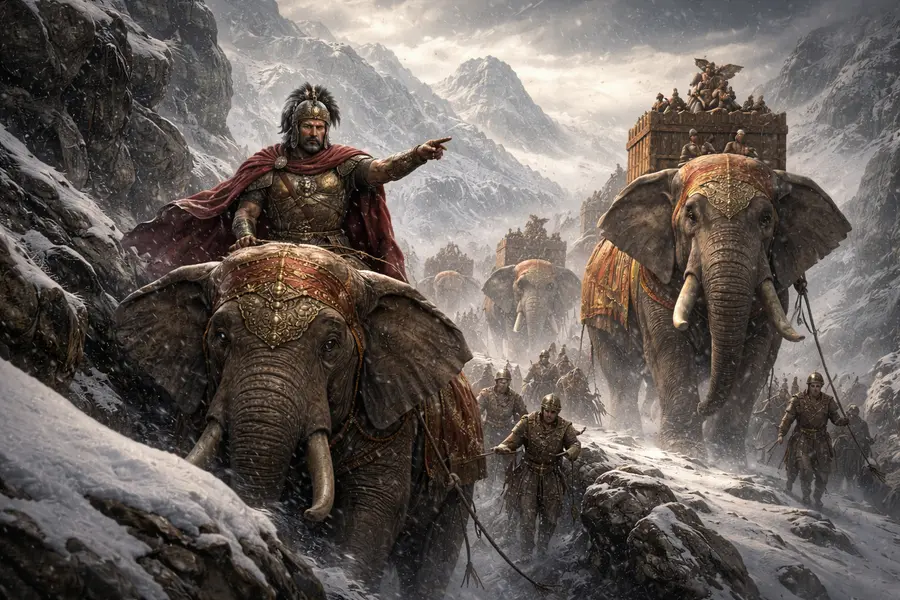
Carthage did not have a strong navy to challenge Rome at sea. So, Hannibal undertook an audacious trip to cross the Alps with his whole army, which included war elephants. This feat was a remarkable achievement and took the Romans by surprise. Hannibal was now on Roman soil. His army was weak and depleted due to the treacherous journey, but his revenge could finally begin.
Rome Gets Crushed by Hannibal
Hannibal was a tactical genius and understood Roman military doctrine. He also knew that their leaders were rigid and arrogant. They rushed into battle seeking glory and believed that the Carthaginian forces were no match for the superior Roman heavy infantry. Hannibal would utilize this to inflict crushing defeats on the Roman armies.
- TheBattle of the Trebia: This was the first major victory for Hannibal in Italy. He used the terrain against the Romans by taunting them to fight in unfavourable conditions.
- The Battle of Lake Trasimene: This was the largest ambush in ancient history with disastrous results for the Romans.
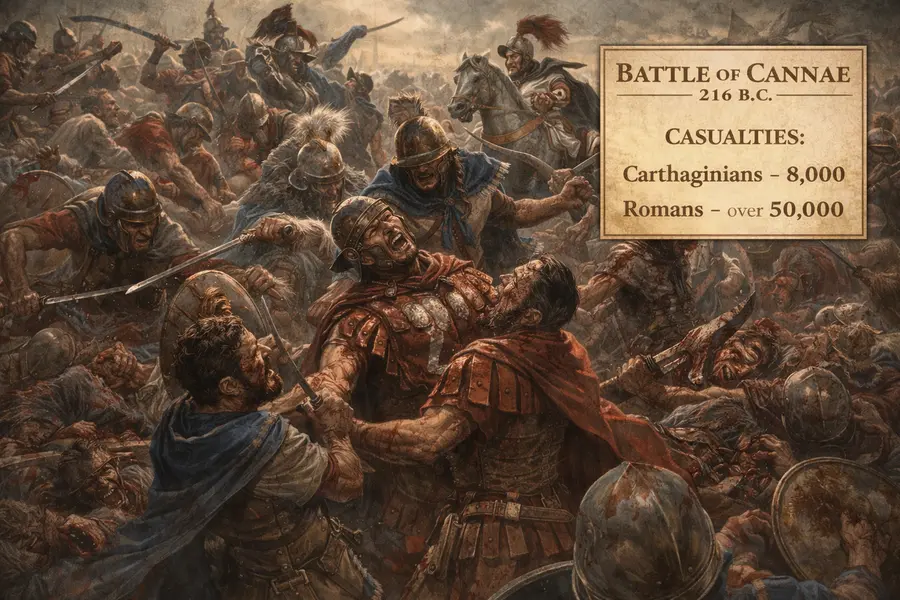
- TheBattle of Cannae: This was the masterpiece of Hannibal, where he showcased the use of the double envelopment strategy. Rome lost 20 percent of its fighting force this day.
Rome Does Not Surrender
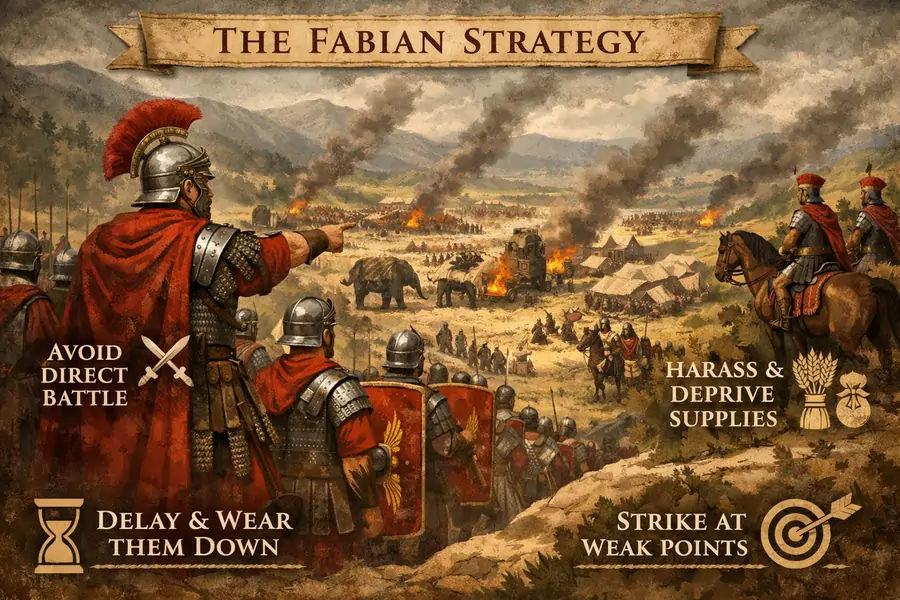
Despite these crippling losses, Rome does not surrender. They lick their wounds and fight on. Rome adopts the Fabian strategy of avoiding engagement and containing the movement of Hannibal's army. This gives them enough time to rebuild their army and engage the Carthaginians in Spain. Scipio Africanus emerges as the dominant Roman general leading the charge against Carthage.
Hannibal is Finally Defeated
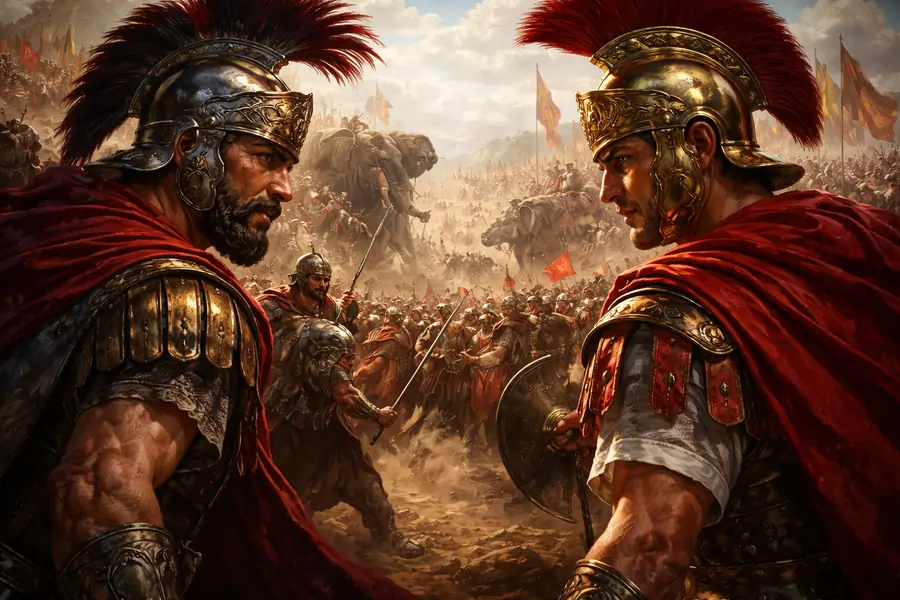
Despite being undefeated in Italy, Hannibal is unable to make Rome surrender. Scipio takes control of Carthaginian possessions in Spain and invades North Africa. Facing an imminent siege, the Carthaginian senate forces Hannibal to return to North Africa to defend Carthage. The showdown is set between the two legends: Hannibal vs. Scipio. At the Battle of Zama, Scipio delivers the coup de grâce and defeats Hannibal, ending the Second Punic War. Hannibal is banished and finally takes his own life as Roman soldiers surround his compound.
The Third Punic War: Carthage Must Be Destroyed
After the Second Punic War, Carthage lost all of its overseas territories, and its navy was restricted. The war indemnities also crippled its economy. Surprisingly, there was a trade boom that brought great wealth to Carthage as it started to prosper again. This was not unnoticed by the Romans, who were always wary of Carthage.
Carthage Must Be Destroyed
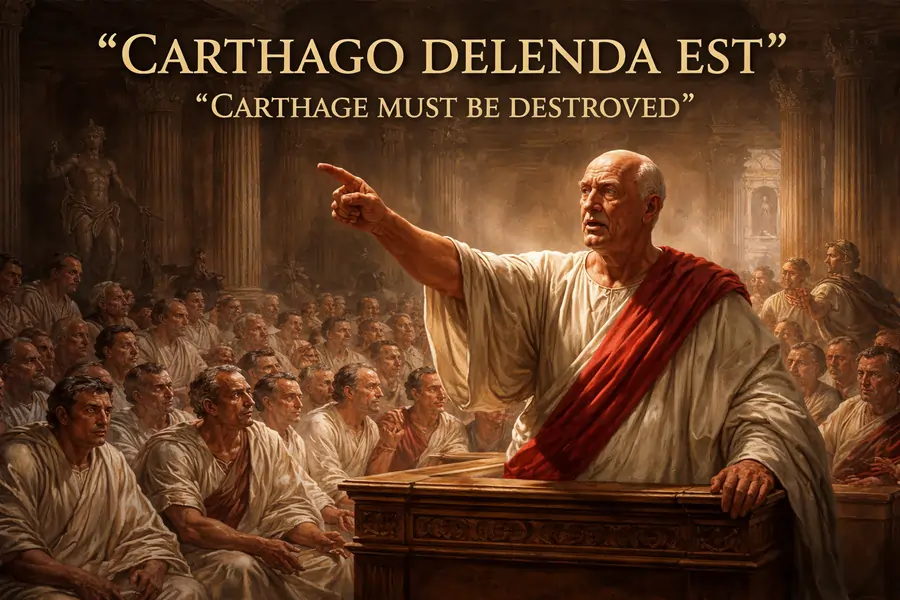
The Roman senator Cato would iconically end all his speeches with the phrase, "Carthago delenda est" which means "Carthage must be destroyed." There was a constant fear in Rome that Carthage would start another war if they recover. Many were jealous of the enormous wealth flowing into Carthage due to its trade boom. The only solution to this was to destroy Carthage once and for all.
Carthage is Forced into a War
Carthage was not as strong as it was during the earlier wars. The Numidian king Masinissa had constantly captured Carthaginian territory, which was untenable for Carthage. When the Romans did not offer to help mediate the issue, they launched an attack on Masinissa. The campaign went horribly wrong and ended with the Battle of Oroscopa, where the Carthaginian army surrendered.
According to the treaty signed at the end of the Second Punic War, the Carthaginians were not supposed to wage any wars without Roman approval. The Romans used this as an excuse to invade Carthage. The Carthaginians tried their best to defend but were eventually overwhelmed by the Roman might.
The End of the War: Carthage is Destroyed
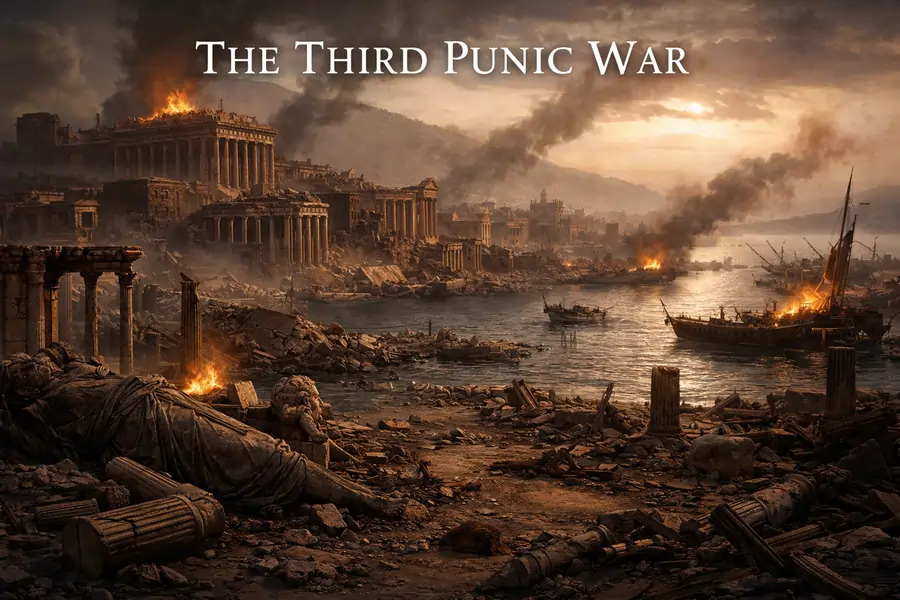
The conflict between Rome and Carthage came to a bloody end with the Roman capture of Carthage in 146 BC. When the Romans breached the city, they slaughtered the population. About 62,000 Carthaginians were killed, and 50,000 survivors were sold into slavery. The city itself was pulled down brick by brick and destroyed. It was left in ruins for 100 years until the Romans rebuilt it as a Roman colony.
Significance of the Punic Wars
The Punic Wars reshaped the course of history. Rome became the dominant power in the Mediterranean, whereas Carthage was lost in history. However, the battles fought, the innovations made, and the military leaders who led the armies would remain unforgotten. This war brings into light the tenacity and resilience of Rome. The Romans knew that losses in battle were unavoidable and necessary for final victory.
Frequently Asked Questions
What were the Punic Wars?
The Punic Wars were a series of three wars fought between Rome and Carthage from 264 BC to 146 BC. These conflicts determined control over the Mediterranean and ultimately led to Rome becoming the dominant superpower in the region.
Why are the Punic Wars considered so interesting?
The Punic Wars are fascinating due to their dramatic storytelling, legendary generals like Hannibal and Scipio, massive battles, innovative tactics, and the high stakes of total dominance over the Mediterranean world.
Who was Hannibal and why is he famous?
Hannibal Barca was a Carthaginian general and one of the greatest military commanders in history. He is famous for crossing the Alps with war elephants and defeating Roman armies in major battles like Trebia, Lake Trasimene, and Cannae.
What was the most important battle of the Punic Wars?
The Battle of Cannae in 216 BC is often considered the most significant due to Hannibal's brilliant double envelopment tactic. However, the Battle of Zama in 202 BC was निर्णायक, as it ended the Second Punic War with Rome's victory.
How did Rome win the Punic Wars despite early defeats?
Rome won through resilience, adaptability, and strategic changes such as the Fabian strategy. Despite suffering massive losses, Rome rebuilt its armies, avoided direct confrontation when necessary, and eventually defeated Carthage.
What was the outcome of the Third Punic War?
The Third Punic War ended in 146 BC with the complete destruction of Carthage. The city was captured by Roman forces, its population was killed or enslaved, and Rome became the uncontested power in the Mediterranean.